Search This Blog

Monday, December 19, 2022

Antoine Vanner talks about his latest maritime thriller


May be an image of 1 person and book

I can't resist sharing a moment of what I hope is justifiable pride. My eleventh novel of the Dawlish Chronicles series, Britannia's Rule, was published last week. When I began writing seriously I never thought that so many novels would follow the first and that they should be so well received in the US, the UK, and Australasia. My main characters are almost as real to me as my own family!
I was not in the first flush of youth when I started, and am even less so now. I hope this will be an encouragement to anybody who believes that "they have a book in them" and who's prepared to put in the necessary time according to a disciplined schedule. In my case it's about 1000 - 1200hrs of researching, plotting, writing, agonising, rewriting, revising etc. that I find needed for a 120,000-word novel. Time marches on inexorably and it's never too soon, or too late, to start.
On now to my twelfth!

Friday, December 16, 2022

Venus Rising, from a dancer's perspective

THE ROYAL NEW ZEALAND BALLET ... presents ...

 Three magical ballets, filmed from the wings.


Saturday, December 10, 2022

A BEST FILM OF 2022

 THE SWIMMERS


I almost missed this wonderful film, because of the title.  Ever since I was forced to watch "Chariots of Fire" with a school party, I have been allergic to sports movies.  But then I saw that it told a story of the Middle East, and I was hooked.

It starts in Damascus -- and it must be a rich area of the major Syrian city, because it is so nice.  Such fun.  The young people, as young people in Arabic countries do, dance wildly instead of getting stupid drunk. Two beautiful young girls, from a loving family.

Dad was a champion swimmer, but his ambitions were foiled when he was forced to do national service, and carry a gun for two years.  Those were the days when many young men were stalled in their goals, and certainly not just in Syria.  It happened in New Zealand, too. Boys who longed to be chefs were taught how to drive a tank.  But enough of that.

To get back to the story, Papa Mardini has focused instead on his two daughters, Yusra and Sara, who are definitely talented.  Especially the younger one, 17-year-old Yusra.  They were also beautiful.  Such wonderful futures lay ahead -- but then Assad staged his civil war, funded by Russia.  While the rebels are funded by Western countries, the USA in particular.  Such tragedy, for such a mean reason.

But enough of that, too.  Yusra and Sara decide to flee to Germany, where they could settle with a friend, and apply to bring over their family.  When the swimming pool where Yusra is training is bombed the parents agree that it is the only, though very dangerous, way out.  So they gather as much spare cash as they can find, and give it to the two girls.

So this is the story of their journey -- through Turkey to Greece, and then on foot to Germany.  Against their father's farewell advice, they accept the offer of a smuggler to get them from a Turkish beach to Lesbos, by boat.  And they pay him.  Along with more than a dozen other refugees -- from many countries, and with many stories -- they are trucked to the beach, and told to wait.  When the boat arrives, it is merely a rubber one with a rickety outboard motor, designed for eight, at the most.  They are hassled into getting in -- and then the smuggler drives away, taking their money and leaving them to it.

The motor dies in the middle of the Aegean Sea, and the boat takes on water.  There are too many people, the load is too heavy.  So the girls, with two others, slip overboard, and tow the boat through the night to Lesbos.  The camera work here is amazing.  The reaction of the locals when they finally land on the beach is less so.  Doors are slammed, windows shut, and there is hostile graffiti on the walls.  But they came across an aid camp, and are given clothes, food, water.

And their journey to Germany begins.  On foot.  Not easy. Another smuggler only half-fufils the bargain.  But they get there -- and there is a system in place for registering refugees, and housing them until they are accepted somewhere. The refugee camp was a revelation to me: I had no idea that aircraft hangers were used, or that the system was so clean and efficient.  But, of course, life there is boring. Nothing to do but fill in forms and wait, wait, wait.  But a miracle happens.  Yusra finds an angel named Sven, who is a swimming coach, and is impressed enough to accept her for his team.  And so she ends up in the Olympics.

I expected to get bored at this stage, but I must admit that the butterfly race is exciting in the extreme.  Kudos to the camera folks and the director.  It was hard not to cry with delight.

This is a true story.  It really happened.  They really did tow the overloaded rubber boat through the Greek Sea.  Watch this film, if only for that section.  But I guarantee you will love it all.


Monday, December 5, 2022

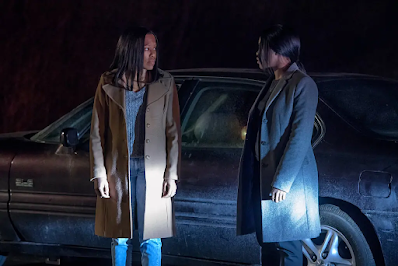
Grim, grim, grim, and very disturbing TV series

 SEVEN SECONDS


Have I never been to New Jersey?  Surely I have.  I lived three years in New York, and visited on book business many times.  But nothing about this depiction of Jersey City rang a bell.  And I certainly don't remember the F-bomb being used as idly and frequently as the word "and" and losing all impact and meaning in the process.  At first faintly offensive, the dialogue became tedious.

And what a scene the series depicts. Black kids selling drugs in the gutters.  White kids selling their bodies for drugs. Crooked cops. Violence in the police station, violence in the streets. Darkness in the extreme, lightened only by occasional glimpses of the Statue of Liberty.

This series is not a mystery.  Right at the start, you learn exactly what happened.  A white cop driving through a rundown park gets a phone call to say his wife is in hospital. While he is panicking and distracted he slams into something, and skids in the snow.  He gets out of the car, to see that he hit a bike.  There is also a lot of blood. Because of the force of the impact the rider of the bike was thrown into the air, and slammed into a deep ditch.

Actually, there is a mystery here -- why didn't the cop do what most of us would do, and simply call for an ambulance?  That is never explained.  You just have to take it on board. Because instead of calling for an ambulance he phones the other cops in his team.  These are effective (if foul-mouthed) drug-busters, partly because the sergeant -- who is very much in charge -- has an agreement with the crippled Black guy who runs the drug trade in his precinct.  As I said, he is a control freak, and as crooked as my elbow, but doing a reasonable job of keeping the drug trade within limits.

This sergeant sums up the scene, says the kid is dead, and because that kid is Black, it is not a good idea to call it in.  So they all drive away.

But the kid is not dead.  Instead, he lies there for 12 hours before a couple of dog-walkers find him.  He is rushed to hospital, and his parents notified.  And at this stage the parents' characters are strongly drawn, but never evolve from then on.  Cardboard characters, but starkly painted.  Both belong to a Gospel church that is fundamental in philosophy.  (Note I do not say "Christian." More about that later.)  Dad is incredibly hardworking, doing double shifts in a slaughterhouse so he can keep up the mortgage payments on his house. Having a house (which we are told his hugely unusual for a Black man) is his great pride, though his long hours did mean that Mom, who doted on their son, was in charge of just about the total upbringing of the boy.

Doting Mom agitates over the hospital bed, and collapses into emotional bits when the boy dies.  And she wants REVENGE.  The vindictiveness is truly awful.  Believe me, it is cringe-making.

However, a young Black lawyer with a grubby past feels exactly the same. In her eyes, as in Mom's, this accident is a HATE CRIME that must be avenged in full.  A hit-and-run that deserves the ultimate punishment.  Mom even procures a gun to carry out the execution herself.  And this is where the series becomes repetitive and boring, because their vengeful, vindictive attitude never wavers. 

When the church backs Mom up, the series becomes truly disturbing.  This is the creed of retaliation found in parts of the Old Testament -- "The righteous shall rejoice when he seeth the vengeance: he shall wash his feet in the blood of the wicked." (Psalms 58:10).  It is NOT the creed of forgiveness that men like Christ preached. "Then Peter came to Jesus and asked, 'Lord, how many times shall I forgive my brother or sister who sins against me? Up to seven times?' Jesus answered, 'I tell you, not seven times, but seventy-seven times.' " (Matthew 18: 21-22.)

Has America forgotten how to forgive?  If so -- and this series certainly indicates that this is so -- the future looks grim indeed.

The dead kid's uncle, Biblically named Seth, is an airforce man who had served in both Iraq and Afghanistan. At one stage he says, "This is not my country."  

And that, indeed, sums up the message of this very one-sided story.

Saturday, December 3, 2022

CALL FOR SUBMISSIONS

 From the Authors Guild


Nonfiction Contests

J. Anthony Lukas Work-in-Progress Award
Eligibility: Writers with a contract with a U.S.-based publisher to write a nonfiction book
Prize: $25,000
Deadline: December 8, 2022

J. Anthony Lukas Book Prize
Eligibility: Writers with a nonfiction book published in 2022 on a topic of American political or social concern
Prize: $10,000
Entry fee: $75
Deadline: December 8, 2022

Mark Lynton History Prize
Eligibility: Writers with a book-length work of history published in 2022
Prize: $10,000
Entry fee: $75
Deadline: December 8, 2022

Poetry Contests

Alice Fay Di Castagnola
Eligibility: All poets
Prize: $1,000
Entry fee: free for Poetry Society members; $15 for non-members
Deadline: December 31, 2022

Robert H. Winner Memorial Award
Eligibility: Poets 40+ years old who have published no more than one full-length collection of poetry.
Prize: $2,500
Entry fee: free for Poetry Society members; $15 for non-members
Deadline: December 31, 2022

Dorset Prize
Eligibility: All poets
Prize: $8,500 + week-long residency
Entry fee: $30
Deadline: December 31, 2022

Multi-Genre Contests

Chautauqua Prize
Eligibility: Writers (fiction & some nonfiction) with a book first published in the U.S., in English, in 2022
Prize: $7,500
Entry fee: $75
Deadline: December 15, 2022

Writing Fellowships & Residencies

Fine Arts Work Center in Provincetown Writing Fellowship
Eligibility: Writers and poets who have not published a full-length book of creative work
Prize: 7-month residency + monthly stipend of $1,250 + $1,000 exit stipend
Entry fee: $40–65
Deadline: December 15, 2022

Thursday, November 24, 2022

WWW thoughts for the day


VENUS RISING


No, this is not an astrological blog; it is a review of VENUS RISING, the latest offering by the Royal New Zealand Ballet.

It features three contemporary ballets that simply celebrate the joy of dance and youth.  No deep messages about the troubling state of our planet, just perfect movement.

The first is AURUM, which features two of the principal dancers, pictured above, Sarah Garbowski, and Paul Matthews.  Paul retired recently after seventeen years with the company, and last night his replacement was the very well qualified British dancer, Damani Campbell Williams.

Choreographed by RNZB alumna, Alice Topp, and created for the Australian Ballet in 2018, Aurum is inspired the kintsugi, the Japanese art of healing cracks in porcelain by filling them with pure, molten gold. The lighting and set design were perfect for this imagery, absolutely brilliant.  The mirror effect was mesmerising, and the streaks of gold just wonderful.

The music was composed by Ludovico Einaudi. It's a name unfamiliar to me, but I find he is very popular, an Italian pianist who experiments with modern musical forms to create his own voice.  The score for this ballet with up there with the best of Philip Glass.  Wonderfully danceable, and the dancers gave their all for it.  Even if there had been just this one ballet, the evening would have been memorable.

The second ballet was THE AUTUMN BALL, which was commissioned by the Wanaka Festival of Colour, and choreographed by Sarah Foster-Sproull.  It premiered there in autumn 2021.  The theme is falling leaves, and the colours that come with the close of summer and the dawning of winter, and again the lighting design -- this time by Daniel Wilson -- was perfectly in sync.  The music was composed by Eden Mulholland, a local (Ngati Uepohatu) and very prolific composer for theatre and dance.


The third offering was WATERBABY BAGATELLES, choreographed by the illustrious Twyla Tharp, and which had its world premiere in April 1994 at the Wang Center, danced by the Boston Ballet. 

Spiced with a great deal of humour (which the dancers very obviously enjoyed) it is a lighthearted play on the fun enjoyed by boys and girls. Apart from being watery, there is no overriding theme, so it really a collection of images of young people having fun.  The music, which appears to have been composed by a whole bevy of names, is an equally moveable feast.  All good stuff, highly enjoyable.

It was a marvellous evening.  Go to the ballet.  You will not regret it.


Saturday, November 19, 2022

Z-Library seized, Russian operators arrested


The Authors Guild makes a sensational -- and very satisfying -- announcement

New York (November 16, 2022): The Authors Guild, the nation’s oldest and largest nonprofit advocacy group for published authors and journalists, welcomed news of the arrest and indictment of Russian nationals Anton Napolsky and Valeriia Ermakova for their role in operating the massive, notorious ebook piracy site Z-Library. The Z-Library network of domains was seized by the U.S. government and taken offline on November 3, 2022, the same day that its two principals, Napolsky and Ermakova, were arrested in Cordoba, Argentina, upon the request of the U.S. government. The pair faces charges of criminal copyright infringement, wire fraud, and money laundering. The court order was unsealed today.

“The arrest and indictment of Z-Library operators is one of the biggest breakthroughs in the fight against online criminal ebook piracy to date,” said Mary Rasenberger, CEO of the Authors Guild. “We owe a tremendous debt of gratitude to the U.S. Attorney’s Office for the Eastern District of New York and to the FBI for all of their hard work in not only shutting down the site but also finding and apprehending the perpetrators. We also thank the U.K. Publishers Association and international authorities who assisted in the investigation, as well as the authors who assisted us by filing statements reporting piracy of their books on Z-Library.”

Z-Library, which had been operational since at least 2009, was perhaps the most visible and high-traffic ebook piracy site in the world, with some of its domains ranking among the top 10,000 most visited websites on the internet worldwide. The site claimed to host 8 million pirated ebooks and 84 million articles through a vast network of “mirrors,” or identical versions hosted on different servers, and had recently gained particular notoriety after trending on TikTok as a source for free ebooks. Substantial traffic to Z-Library domains originated from the United States.

Over the past year and a half, the Authors Guild worked with the U.S. Attorney’s Office and the FBI to assist their investigation and indictment of Z-Library principals. Among other things, the Authors Guild provided testimony and examples of substantial harm that Z-Library’s activities were causing working authors. The Authors Guild also alerted the U.S. Trade Representative’s Office (USTR) about the scope of Z-Library’s pirate activities in its comments in response to the USTR’s annual Review of Notorious Markets for Counterfeiting and Piracy.

“While we are heartened by the takedown and the resulting reduction in harm to authors,” Rasenberger continued, “we are not unsympathetic to the plight of those college and other students who have perhaps felt forced to resort to such illegal pirate websites and other free sources of textbooks to help them manage the extremely high cost of higher education. However, these students’ anger is misdirected. The exorbitant cost of education should not be borne by authors and publishers but by the universities, and it should not be used to justify reliance on foreign criminals for textbooks or to trivialize the immense personal and economic harm Z-Library was causing authors who are trying to make a living under increasingly difficult and hostile economic circumstances.”

The Authors Guild will continue to follow updates in this case.

About the Authors Guild

With more than 12,000 members, the Authors Guild is the nation’s oldest and largest professional organization for published writers. It advocates on behalf of working writers to protect free speech, freedom of expression and authors’ copyrights; fights for fair contracts and authors’ ability to earn a livable wage; and provides a welcoming community for writers and translators of fiction, nonfiction, poetry, and journalism. Through its educational and charitable arm, the Authors Guild Foundation, it also offers free educational programming to empower authors in the business of writing, as well as organizing events that highlight the importance of a rich, diverse American literary culture and the authors that contribute to it. For more, visit www.authorsguild.org.


Friday, November 4, 2022

Merger of Penguin-Random and Simon & Schuster blocked


Authors Guild Celebrates Court’s Decision to Block Penguin Random House-Simon & Schuster Merger in DOJ’s Antitrust Suit

New York (Nov 1, 2022): The Authors Guild, the nation’s oldest and largest nonprofit advocacy group for authors, celebrates the D.C. District Court’s decision to block the merger of Penguin Random House and Simon & Schuster in an antitrust action initiated by the Department of Justice last November. In a summary order rendering her decision, U.S. District Court Judge Florence Pan wrote that the DOJ had successfully shown that “‘the effect of the proposed merger may be substantially to lessen competition’ in the market for the U.S. publishing rights to anticipated top-selling books.” The full order is under seal pending the parties’ redaction of confidential information.

“This decision is a major victory for authors,” said Authors Guild president Doug Preston. “This is the first time a court has recognized what authors and the Authors Guild have been arguing for decades: that consolidation among publishers hurts authors. It leaves authors with fewer potential buyers of their manuscripts, which restrains their power to negotiate advances and other terms.”  

If successful, the merger would have drastically cut competition in the publishing market. According to the economist Nicholas Hill, who testified as the DOJ’s expert witness during trial, the merged entity would have had a 49 percent market share, far greater than its next biggest competitor HarperCollins’ 22 percent. The Authors Guild has cautioned that this degree of market power concentration makes competitive bidding and auctions less likely and drives down what agents are able to negotiate in advances. Publishers also have a greater incentive to spend on book marketing when they must recoup a large advance, which has a substantial impact on visibility and authors’ earning potential.

The Authors Guild has opposed consolidation among publishers going back five decades to the 1970s. Over the decades the Authors Guild has issued reports and statements and testified before Congress in response to the growing trend of large publishers acquiring smaller firms. When the merger between PRH and S&S was announced in 2020, the Guild called for the Department of Justice’s antitrust intervention, pointing out that “the history of publishing consolidation has also taught us that authors are further hurt by such mergers due to editorial layoffs, canceling of contracts, a reduction in diversity among authors and ideas, a more conservative approach to risk-taking, and fewer imprints under which an author may publish.” The Guild voiced its support for the DOJ’s lawsuit and consulted with DOJ attorneys on the merger’s impact on authors. Many of our arguments to the DOJ were reflected in its complaint.

“The consolidation of publishers decreases the overall diversity—in the broadest sense—of books that get published,” stated Authors Guild CEO Mary Rasenberger. “As the DOJ recognized in its complaint, it means that fewer authors will be able to earn a living writing, which impacts their ability to write books. Moreover, every publisher has a unique personality, taste, and risk tolerance. The fewer publishers there are, the fewer ideas and voices are reflected in what gets published. We lose out on authors that present unusual or controversial ideas, those from overlooked and marginalized communities, and literary writers who challenge the status quo both in content and style.

“The decision is particularly exciting for us because it shows that the court understands that monopsonies—the concentration of power among one or a few large buyers—are as harmful to competition as monopolies where sellers control pricing,” Rasenberger continued. “This is particularly true where the suppliers are authors or other creators who have almost no ability to negotiate most terms of their contracts. And in the case of books, it is particularly important since books are so crucial to the exchange of ideas necessary to support democracy.”

The Authors Guild looks forward to reading the full order when published.