Search This Blog

Friday, July 17, 2026

SUMMER '36


This six-part Netflix series in French (with subtitles, of course), is loosely based on Agatha Christie's Murder on the Orient Express.  English "cosy" mysteries of the Midsomer Murders type don't usually adapt well to foreign versions, but in this case it works very well indeed.

The series is set in Nice, and as the title suggests, in the year 1936, when the shadow of Hitlerism and fascism is spreading over Europe.  Despite the growing menace - and the surreptitious appearance of German secret police -- the festivities go on as usual, with wonderful costumes, and plenty of cheerful effects.  I really enjoyed the sights of abbes and nuns in traditional garb in the crowded streets.

The story revolves around four young women, related in various ways, plus two older ladies, the mother and aunt of two of the young ones. They are equivalent to the passengers in Christie's train, but it is impossible to tell just how they are involved in the series of murders, each of which happens at the end of an episode.

Nice is particularly cheerful in the summer of 1936, as workers are celebrating their first legally paid holiday, and are (sort of) finding their feet in the swanky resort. One of the workers is married to one of the four young women, Eugenie Berthier, who is the heiress to a factory, and is visiting her estranged father for the first time in 17 years. Naturally, there is conflict, particularly when her 16-year-old niece falls in love with her worker husband's working young brother.  Her sister, Blanche, is involved in a very tawdry love affair, while her husband (though unknown to her) is secretly saving Jews from the Nazis.

And then there is Leonie Morel, an apprentice detective, who is working for the Nice police surreptitiously, as she is really trying to clear the name of her father, who is due to meet the guillotine for a murder he did not commit.  And her sister, Guilia Vincent, is also in Nice, working in a high - and very vulnerable - position at the luxurious Riviera hotel -- where a famous prosecutor is murdered in episode number one.

It is wonderfully complicated, and compulsive viewing.  The actors are all amazing, but I have to admit the one I liked best was the policeman in charge of the cases, Inspector Raven.  For a start, he is not dumb.  He actually solves the case -- but in an unusual kind of way.  The actor, Francois-Xavier Demaison, is so very good that I will be watching out for his name in the future.

Highly recommended.

Wednesday, July 15, 2026

TEASING AI


Some people love to tease cats or dogs (neither seem to mind, but play along with enthusiasm), but my current hobby is giving AI a hard time.

It began when I was annoyed by wrong answers.  I needed to register my plan with my new pdf program, and appealing to AI for help turned out to be useless.  I was advised to log in, and when that did not work, to do all the usual things like reboot the computer, clear my browsing cache, fiddle with the modem, and so forth and so on.  Finally I did the sensible thing, and appealed to the program's help desk.  I got a reply, and that right away, and apparently from a human.  Logging in was wrong.  I simply had to open the website, and look for settings. Voila!

So, what a blessed waste of time.  AI is simply Google on steroids -- and Google is now Meta AI, anyway -- and human understanding is beyond it.  For instance, when I asked for a suitable cartoon to put at the head of this blog, I got this answer:

'The viral AI cartoon trend' (which I had not asked for) 'involves users uploading selfies to generative AI platforms like ChatGPT and prompting the model to generate exaggerated, cartoon-style caricatures of themselves at work.'

Good lord and crikey dick, why don't these people get lives?

Instead, I have fun teasing the system.  One advantage of AI, I found is that you can ask long and complicated questions.  For example:

What was the lading of the trader brig Tybee when it arrived in Salem from Sydney on 20 October 1833?

Well, the little word 'Searching ...' came up, and after that I could almost hear the whirring as the question filtered through miles and miles of stratosphere to a multitude of data servers that were gobbling fresh water and electricity as they pondered.  Then a list of sources came up, mostly to papers and books I had written myself, plus a recommendation to consult 'the maritime collections and archives specific to the New England shipping trade.'

In a word, it was telling me to research it myself.  Personally, if a researcher came up to me with the same question, I would recommend searching Salem newspapers through the website 'Chronicling America' -- or else go to Wikipedia.  But that is by-the-by. The obvious conclusion is that AI is not going to replace people any time soon.


Saturday, July 11, 2026

WITH ONE MIGHTY LEAP


My brother and I were not allowed to read comics

I'm not sure whether my mother thought they were bad for the eyesight, or bad for the morals, but it was a very strict regime.  So, though we were both voracious readers of "real books," whenever we visited friends, we dived into their comic collections with huge delight.

And a definite favorite was the English boys' comic book, The Eagle.  Though we didn't know it, the Eagle was a Christian response to the popular American comics, which the founder of the English  production, an English vicar, John Morris, thought were "deplorable, nastily over-violent, and obscene." So he had envisioned a comic book that was replete with action stories that were fun to read, but also conveyed respectable moral standards.  No foreigners would be depicted as villains or enemies, and in every group there would be at least one from an ethnic minority.

The Eagle, however, was not preachy at all.  In fact, it was exciting.  It introduced me to science fiction.  It's hero, Dan Dare, Pilot of the Future, was inspirational.  He could be relied on, in any situation, to get out of trouble with amazing feats.  The feats felt authentic -- one of the writers was a very young Arthur C. Clarke. And the drawing was of very high quality.

Years later, when I had children of my own, to my amazement I met one of the men who had written for the Eagle -- not Arthur C. Clarke, but a fellow who could tell very amusing stories.  When he worked for the magazine, he said, he had been one of the two writers of the Dan Dare stories.  And he and the other writer had a private contest - each had a six (or so) week with the stint, and then handed Dan over to the other writer, having left their hero in a very tricky situation. 

Which the other writer had to solve.

Well, the other writer was in France, one time, and so, as my raconteur confessed, he thought he would create a situation that was utterly and absolutely impossible.  He dropped Dan into a 40-foot deep hole with sheer sides, with snakes and scorpions swarming at the bottom, and then headed off to France himself.

When he got back to London, he grabbed the comic with glee ... to find that WITH ONE MIGHTY LEAP out Dan had jumped, to carry on with his mighty deeds.

So Dan Dare was what we call today an action hero. 

I was reminded of this the other day when I picked up the second in the Orphan X series of books, The Nowhere Man, by  Gregg Hurwitz.  Orphan X, also known as Evan Smoak or the Nowhere Man, is definitely an action hero.  Taken out of an orphanage at the age of twelve, he was metamorphosed into a world-class assassin by dark forces in the US administration. Breaking away from this grisly business after a career of offing a large number of nasties, he now operates alone, and on the side of good.

Well, in The Nowhere Man, Hurwitz places his hero into all kinds of impossible situations. Somehow, X gets out of them, only to be recaptured and placed into yet another impossible situation.  In one, he is trapped in a kind of plastic cube, ready to be auctioned off to a large crowd of nasties who all hold a grudge because of what he has done in the past, and contemplate terrible things to do to him if they win the auction.

But, with the equivalent of ONE MIGHTY LEAP, he escapes yet again.

Marvelous stuff. Worthy of all the action heroes that went before him -- Superman, Batman, James Bond, the Saint, Robin Hood, and a personal favorite, Modesty Blaise.  They were not just in comics, but also on radio and in film, depicted by such flamboyant actors as Douglas Fairbanks, Errol Flynn, Roger Moore, Sylvester Stallone, and that Arnie fellow whose name I have trouble spelling.

The world definitely needs action heroes, complete with their liberal standards. Right now, in fact, it seems imperative. An action hero or two could solve of lot of current problems. Watching one at work would be really nice.

Unfortunately, they do not exist.


Thursday, June 18, 2026

A HISTORIC VOYAGE -- THE LANYU BOAT RIDES AGAIN


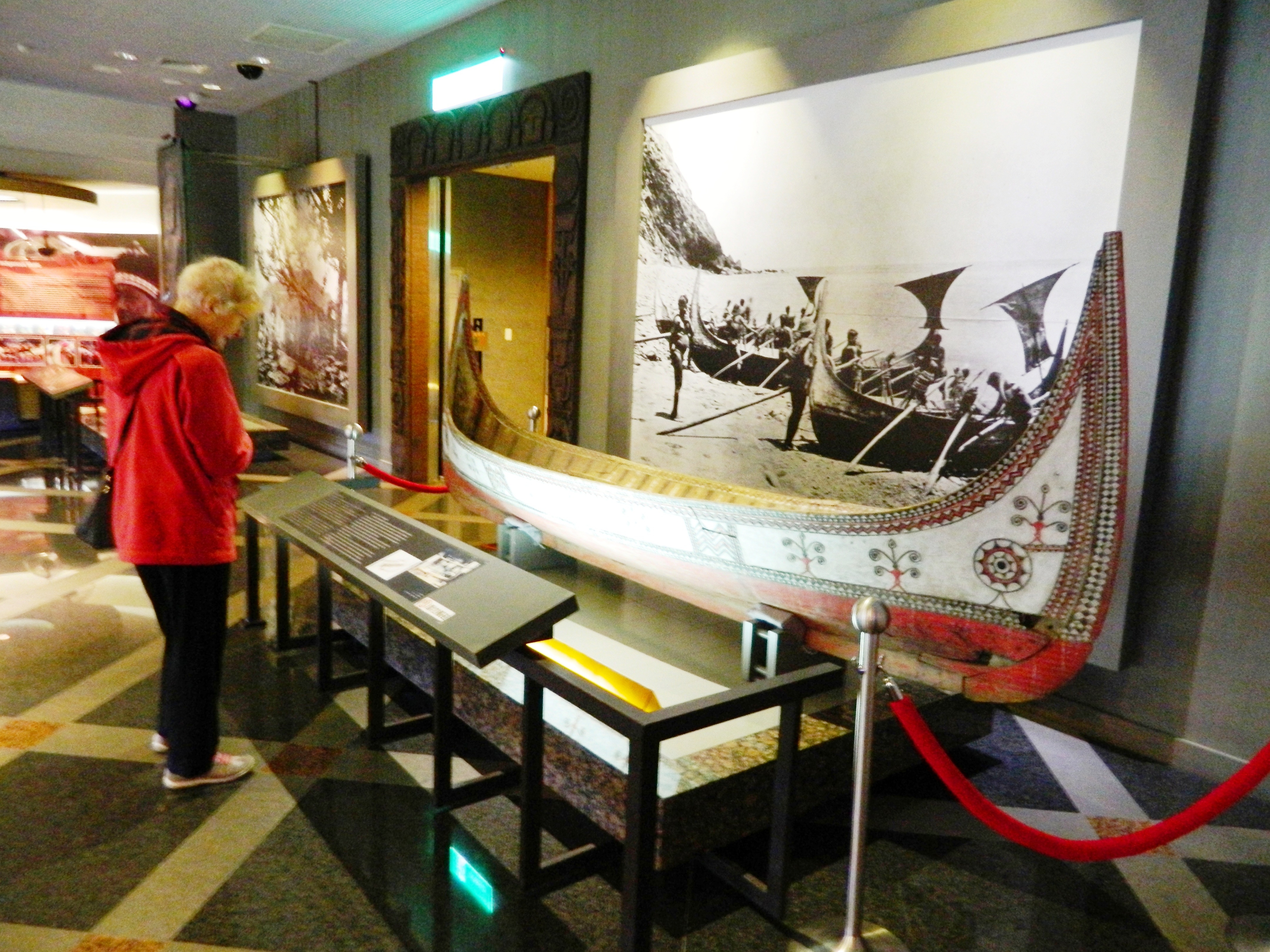
Over ten years ago, I had the privilege of spending a couple of weeks in Taipei, and spent much of it exploring amazing parks and museums.  One was the Evergreen Museum, where I found a Lan Yu "canoe".  It's a cherished memory.

And, turning on CNN this morning, I was riveted to find that a Lan Yu boat has set forth again, on the traditional path to the Philippines.    You can see it HERE

Well, for background, here is the post I wrote for Old Salt Blog, in March 2015, describing my encounter with these 'canoes' and the remarkable people who are bringing back tradition.


Lan Yu “Canoes”

We are very pleased to have a guest post from Joan Druett, who recently visited Taiwan. Joan is the multi-award winning author of more than 20 books, including her latest, Lady Castaways and Eleanor’s Odyssey.

A priority for anyone from the Pacific who visits Taiwan is the Shung-Ye Museum of Formosan Aborigines.  After all, it is now both scientifically and popularly believed that the greatest migration of seafarers in history — the discovery and settlement of the islands of the Pacific — began in Taiwan.  It was from the east coast of this mountainous island off the coast of mainland China that the people we now call Polynesians set out on their epic voyages.  Our New Zealand Maori are distant cousins of the Formosan Aborigines, with a great deal in common, both in appearance and in personality. There are echoes of the local language in Maori te reo.

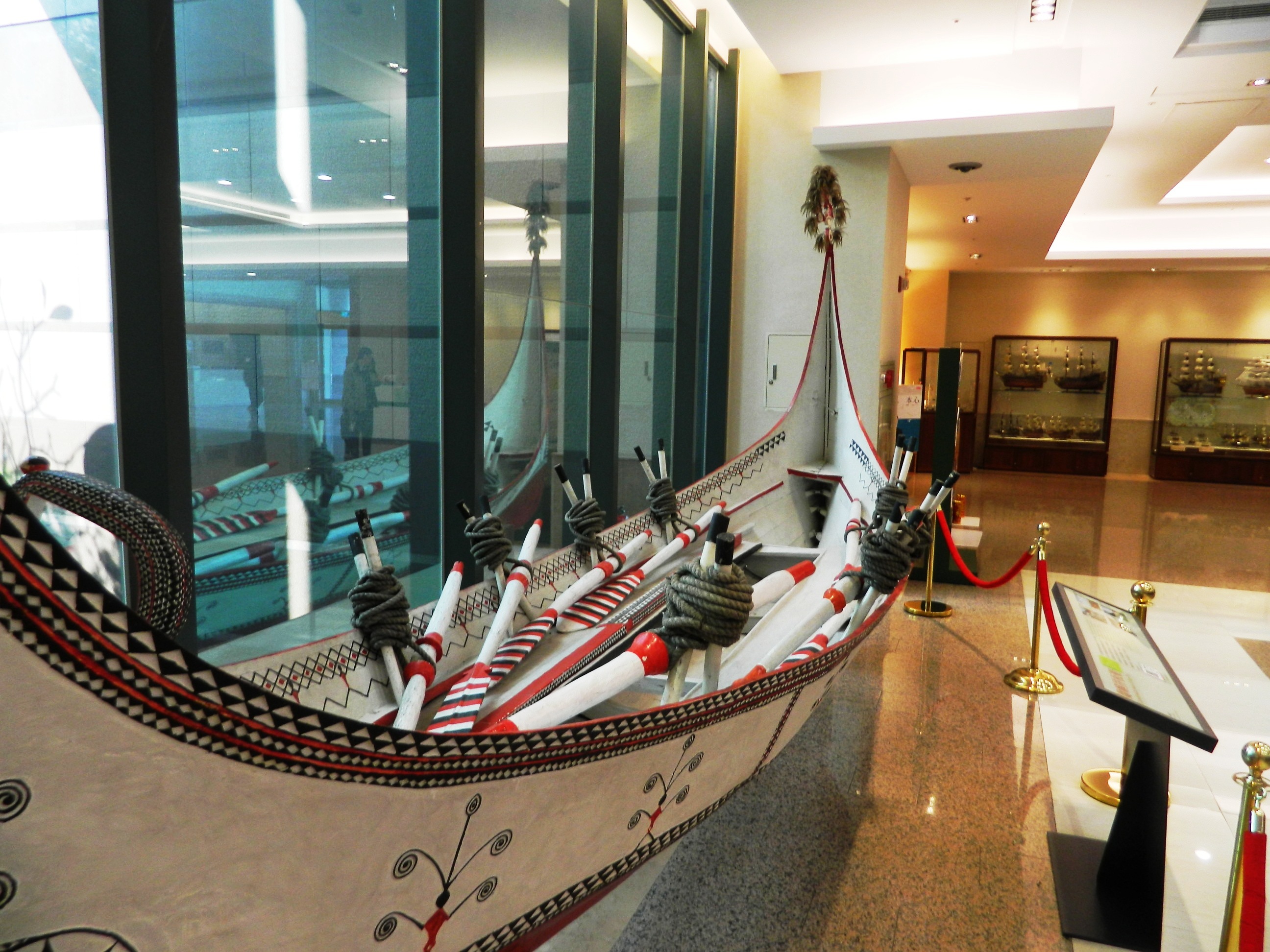
So here I am, gazing at a local canoe with some bemusement.  Called a “balangay, it is not a canoe at all.  As you can see from the following photos, taken at the marvelous Evergreen Maritime Museum in Taipei, a balangay is equipped with what could be called “row locks,” and is equipped with oars. The crew sit on small spreaders, or thwarts, and row in what we think of as the European fashion. It is not built on a dug-out keel, but entirely planked. There is not a single piece of metal in the carvel-built craft. The planks are fixed with wooden pins, and rope — probably sennit, originally — secures the rest.

???????????????????????????????

044 - 12 Feb.

These are fascinating craft.  I had the privilege of meeting Syaman Rapongan, a native of Lan Yu (Orchid) Island, an islet off the southeast coast that is inhabited by his people, the Yami.  As he says, building fishing boats is the most important craft of the Yami people, being essential for survival and livelihood, and also a way of proving one’s manhood. For a Yami youth, building his first canoe is a rite of passage.

Syaman Rapongan had his father as his mentor. Together, as he wrote, they went into the hills to choose and cut the fourteen different trees that each provide a part of the craft.  The trees have names — Apnorwa, Isis, Pangohen, Cyayi.  Each one provides timber for a certain part of the hull. Cyayi provided the keel.

Syaman’s father first prayed to the tree, and then said more prayers as he cut into the trunk. He says, “Trees are the children of the mountains. Boats are the grandchildren of the sea.” It is especially important to come to terms with the spirits of the hills during the felling of that first tree, for the keel of the boat. Then the cutting of the next 13 trees follows. The wood is cut into planks of three or four centimeters in width, of varying curves and shapes, and then everything is brought down from the hills to the beach, where the boat is assembled.

The decorations, I gathered, are equally traditional, each village having its own patterns. Final decorations are the rooster tails at the prow and stern, made of real feathers.

But what are they like in the water?  Syaman Rapongan has some hair-raising tales of sudden storms, and overwhelming waves, of long hours where his crew rowed like madmen, only to get nowhere. So, were balangay anything like the craft in which the first voyagers set out at the start of the great migration, five thousand years ago?

Very unlikely, says Liao Hong-Ji, the founder of the Kuroshio Ocean Educational Foundation.  Through an interpreter, he theorized that it was most likely a drift voyage, perhaps on a raft. The Kuroshio (Japan) Current flows past eastern Taiwan at different rates according to the season of the year. There are variations according to the moon, as well.  From the hills, the current looks like a twisting river. But, at the right season, a man could drift to the Philippines on the breast of it, he said.  And in fact, he went on with a serene smile, he is going to try it this year. By himself, on a solitary drift voyage.

Sunday, March 15, 2026

A MOST REMARKABLE AMERICAN SEAFARING WIFE


Can you imagine being alone with three small children in the bustling port of New Bedford in the very early 1860s, and hear the news that your husband - on whom you depend for your daily upkeep - has expired at sea?

Well, this happened to Sarah Wood Howland Devoll, the wife of Captain Zebedee Devoll.  And how she coped is an inspiring story.

On August 28, 1851, Zebedee Devoll (born in New Bedford 18 November 1817) married his first cousin, Sarah W. Howland, in Dartmouth, Massachusetts. He was 35, she was just 16 (born 17 January 1835), and it was a first marriage for both. In July 1852 they had a daughter, Sarah jr., and in 1856 a son, named Augustus, followed by another daughter, Ida, who was born in Honolulu on 24 November 1858, during the voyage of the Roman. When the ship had sailed from New Bedford in November 1855, Sarah had taken a servant with her, an Irish girl named Abby Noonan, who married a widowed whaling master, Frederick Coggeshall, on 29 November 1859, while Sarah and her children were in Honolulu, and Zebedee Devoll was sailing back to Hawaii after a season a-whaling in the icy north.

 The Roman, which had been doing well in the Okhotsk Sea, arrived in Honolulu four days after the birth, on November 28, 1858 — evidently in time to witness the marriage, as well. They sailed away on December 29, Devoll declaring that he would cruise and then head home. On February 18, 1859, the ship was reported off French Rock, bound for the Bay of Islands ‘on account of the sickness of Mrs Devoll’ (Pacific Commercial Advertiser April 28, 1859). The ship was reported back in Russell, Bay of Islands, on February 20, 1859, but Sarah (or her baby) must have recovered, as Devoll’s only report was that he had shipped most of his oil, to make room in the casks for any whales he might capture on the way back to New England.

The ship arrived home on June 9, 1859, and in August 1860 Captain Devoll sailed again, in command of the Lagoda.  Sarah and the children were not with him.  Instead, they stayed in New Bedford, as Elizabeth Marble, wife of the captain of the Awashonks, made plain in a December 31, 1860 sea-letter. Her ship hadmade a mid-sea social visit with Captain Devoll, ‘the one that bought Capt. Topham’s place and it was his wife the Capt. Cogshalls wife went out survant with ...’ and Mrs. Marble certainly would have mentioned Captain Devoll's family if they had been there.

Captain Zebedee Devoll died at sea of ‘Java fever’ (possibly dengue) in September 1861. The crew carried on with the voyage, arriving back in New Bedford on 18 April 1864, but of course the news of his death preceded that. On 2 May 1862, Sarah made sure that debtors could not seize her inheritance, by applying for guardianship of family and property. This was highly unusual, signifying that she was shrewd, as well as very confident.  She also went to the owners for her widow’s share of her husband’s last voyage, receiving $2619.92, a good sum at that time.  

This resourceful woman then set about establishing her own career. Never again was she going to be dependent on a husband for the upkeep of herself and her children – and so she went to medical school. In 1872 she graduated from the New England Female Medical College, Boston, and went on to practise medicine in Portland, Maine, as there was nowhere in Boston that would employ female doctors. Portland was a good choice, as a branch of the Female Medical Education Society of New England was there. Sarah did even more than that – with grit and persistence, she made her mark by being the first woman in history who was allowed to join the Maine Medical Association.  

In the 1880 census she is listed as widowed, living in Portland, Maine, and working as a physician, while the daughter who had been born in Honolulu is a medical student. Dr. Sarah Devoll authored many papers — ‘Dress Reform’ and ‘Hygienic Value of Labor’ – plus much about the need for women in the treatment of the insane. She featured on the boards of charities, and was involved in the Women’s Rights movement. From 1888 Sarah was the government physician for the Sioux Indians at Standing Rock Agency, Fort Yates, in the territory of Dakota. She died 30 October 1922 in Boston of pneumonia, aged eighty-seven. Unusually for her time, too, she was cremated. 

A remarkable woman indeed.

Thursday, February 26, 2026

The Mystery of the Attack on the Schooner HENRIETTA, 1860


The mystery was first unveiled in the United States by the Daily Evening Traveller, of Boston, December 31, 1860, which reported the massacre of most of the crew of the whaling schooner Henrietta ‘in the port of Buckatoo.’ (Santa Isabel, Solomon Islands) Captain Brown ‘had his wife and two children on board’ and he and his wife escaped to the cabin, ‘where they kept up a constant firing on the natives.’

Well, it did not quite happen like that. There is a long description of the attack and its tragic outcome, taken from the logbook, published in the Sydney Empire, 22 September 1860, page 5:

‘Thursday, June 7th, 1860, a.m., calm fine weather vessel lying at anchor at the island of Isabel in the port of Buckatoo; at daylight pumped ship, washed decks, and sent the small boat away for two casks of water; at eight a.m. boat returned; throughout the forenoon several canoes came to the vessel, with little or nothing in them ; at 9 a.m. sent the long boat away with ten natives belonging to the vessel to cut firewood; the small boat went in charge of the carpenter, to cut two spars, one for the maintopmast, the other for a spare main gaff; saw them from the vessel bring one spar down, and put in the water after that saw no more of the carpenter, or four of the crew alive; one native having made his escape and swam towards the vessel about noon, there being from forty to fifty natives of the island on board with one of their chiefs; they made an attack to take the vessel; there only being on board at the time the captain, his wife and two children, myself, the cook, and four natives belonging to the ship, two of them being down below at the time; they first of all laid hold of the captain and attempted to heave him overboard, but he instantly broke loose from the whole of them with the exception of the chief, who ' hung on' round his neck he managed to get down the cabin, taking the chief with him. 

'He laid hold of a musket, which he fired over his shoulder at the chief, who still managed to keep at the back of him, but without effect, the chief managing to keep the muzzle of the piece clear of his body. The captain then got hold of a pistol, and presented it at liim, which missed fire. I was at the forepart of the vessel at the time, and knew nothing of it till I was laid hold of myself; it was done so quietly and quickly. But, however, I broke loose from them also, and made my way for the cabin, through the whole of them; managed to get down somehow, but how it is impossible for me to say. 

'The captain's wife was attacked by some of the natives that were aft, but she broke loose from them also, and made her way for the cabin. She likewise seized a gun, and put it to the chiefs breast, but the cap missed ; he then made his escape on deck, and I believe overboard ; we fired at them, but to no effect: the captain ordered the whaleboat to be hauled up; but happening to see his little girl in the water, with a native hold of her towing, he then called to two of' our own natives to jump over and bring his child back, which they effected ; but the captain’ s little .boy (aged five years), we could not tell which way he went, but have a strong idea that he was passed into a canoe as soon as the captain was seized ; the boat being alongside, the four natives and myself jumped in, with six muskets, powder, and ball, and gave chase to the men in the water, and the canoes which they left on: the rest our men destroyed ; I fired at two of them ; the one went down, and the other lay floundering on top of the water ; we pulled up to him, when a native hove a spear at him, but he still not going down, I ordered one of my men to jump overboard and hit him in the head with a tomahawk, which he did, and he then went down ;

'I re-loaded my guns, and then ordered long boat and crew to pull after the crew of the small boat, while I laid outside of the reef, to protect their landing in case of a surprise. They brought the small boat out, but all of her crew were chopped in the head, and perfectly dead, one of them lying in the boat ; we then pulled towards the vessel, dropped the boats astern, with the exception of the whale boat, which we kept for the purpose of towing, with the wind very light. This contains the first twelve hours of Thursday on account of commencing the sea log.

'Friday, June 8th, 1860. — Immediately on our return to the vessel, manned the windlass, and hove the anchor up, made sail, and worked out of the harbor ; at two p.m. hoisted the boats on board, so that they would not impede the vessel's progress. At four p.m. cleared the harbor, hoisted the whaleboat up, stowed anchors and put chains below, stood towards Cape Marsh throughout the night, wind very light.

'Saturday, June 7th, 1860, p.m. — Light winds and calm weather, standing in for Bussel's Island. At 4 p.m several large canoes came off; at last the chief came off, whom tin! captain wanted to go across to Buckatoo, to see if he could purchase his little boy.  He held out every inducement, and tho chief said he Would send across, and for the vessel to return in two or three days, which we did, but did not get the child.

— Signed, John Brown, master, Alfred Waugh, mate.

The account then goes on — 'On the return of the canoes which the chief sent to Buckatoo the natives informed us that the boy was alive and well, and that there was no danger of his being killed, but they were unable to recover him.'

Thus, though the survivors were able to save the captain’s little girl, who was in the water, his small son was captured and taken away in a canoe.  He was just five years old.

And there was more news: A letter dated 7 December 1860 published in the Empire 19 January 1861 and written by Brown suggested the Henrietta was condemned at Port de France leaky as Brown related he now has no ship. And the Sydney Mail, 2 February 1861, record positive information that Captain Brown's son, taken out of the Henrietta by the natives, had been accidentally drowned in a canoe.

 # # #

The extract from the log had been released to the papers by the Rev. John Dunmore Lang, who had written to the Sydney authorities pleading official rescue of the little boy.  This had had no success, which was why he made the affair public.  Rev. Lang, according to the Australian Dictionary of Biography, was a Scottish Presbyterian minister who agitated for many worthy causes. He arrived in Sydney in 1823, and established the first Presbyterian ministry there, something that was greatly welcomed by the Scottish inhabitants of the bustling port, who gave him substantial support – one of whom was Captain John Brown. For Brown, it seemed that the minister was the right person to plead his case, which was why he sent him the log extract, accompanied by a letter.

The Rev. Lang wrote his own letter to the papers, with the log extract attached. It was addressed to the editor of the Empire, and began, ‘Sir, permit me to request the sympathies of your readers (and especially those who may have it in their power to assist in any way in rescuing an unfortunate fellow creature from the hands of the bloodthirsty natives of one of the islands of the Western Pacific) in behalf of the unhappy parent whose case it detailed in the subjoined extract of the log of the schooner Henrietta.

‘Captain Brown, the master of the vessel, having been married by me to his present wife a good many years since, addressed to me a letter, which I received in the early part of last month, enclosing the relevant extract from the log of his vessel: requesting me to bring the case under the notice of the authorities here, with the view to some effort being made by them for the rescue of his son, who has unfortunately been carried off by the natives of one of the Solomon Isles, and is now supposed to be in captivity in their hands. Captain Brown was lying unwell in Port de France, New Caledonia, and his vessel was in a leaky state.’

From this, it is perhaps possible to establish the identity of Captain John Brown, by looking up the list of marriages conducted by Rev. Lang. There are three grooms named Brown on the list, but only one John – John Brown, who married 16-year-old Caroline Cubitt at Scots Kirk, Sydney, on 19 June 1829.

The marriage details reveal that Caroline had been born in 1813, the daughter of Daniel and Maria Ann Cook of Sydney, while John Neathway Brown had been born in 1797, so was twice his bride’s age. In 1830 they had a daughter, Caroline Matilda Neathway Brown, who died three years later. Another daughter, Elizabeth Neathway Brown, was born in 1836, and then a third, Mary Ann Neathway Brown, in 1838.  Margaret was born in 1841, and Lucy Ann in 1843, then finally a son, John Henry Neathway Brown, in 1847. Sadly, he died in infancy. A second son, Samuel, was born in 1849, then Thomas Neathway Brown was born in 1855. Being five years old in 1860, it seems apparent that Thomas was the little boy who was carried away by the natives. Though not known which of the daughters was on board the schooner during the attack, it was probably Lucy Ann, who was seventeen at the time.  The other daughters, Elizabeth (24), Mary Ann (22, married to James Devine), and Margaret (19) were old enough to look after the family property while the parents were away, with 13-year-old Samuel to assist.

Back in 1831, John Neathway Brown had invested in a 100-acre property at Botany Bay and built a fine two-storey home, known as Boomerang House. According to the official records, he was known as Mr. John Brown, Market Gardener, which makes his foray in the schooner Henrietta mysterious. The logbook indicates that he was trading for something or other from the natives, which may have been tropical produce, such as coconuts, that he intended to sell on his farm. It was also the blackbirding era, where natives were enticed on board Australian vessels, captured, and carried off as indentured labor, so there is a remote chance that he was looking for farmhands, though this seems unlikely, considering his Presbyterian background. It is also possible that he intended to top up his fortune by whaling.

The schooner had a long history of whaling, leaving London first in August 1830, and finally recorded leaving that port in 1858, with Captain Brown in command. He had either been appointed by the owners, Wilson & Co., or had bought the Henrietta on his own account. Whatever the reason, it proved to be a fatal choice.

John Neathway Brown died not long after the disaster, in March 1865, and is buried in St. Peter’s Cooks River Cemetery in Botany Bay. A direct descendant of his is the Australian actor Bryan Brown (Breaker Morant). According to the inquest, John's body was discovered by his daughter Mary Ann.  She went upstairs to check on him and found him collapsed by the side of his bed.  She ran downstairs to fetch her sister, Elizabeth, who inspected the body and declared him dead. Dr. McKellar, who had attended him for 15 years, testified that Mr. Brown had been complaining of dizziness.  The conclusion was that he had died of an apoplexy, and the verdict was death by natural causes.

Mary Ann, who had married in 1856, died in 1859, adding to the family tragedy.  What happened to Caroline is unknown.

Newspaper references as cited; whalinghistory.org; list of marriages performed by Rev. Lang:  https://www.fellowshipfirstfleeters.org.au/cjsmee_database/sks_m_4t.htm; description of property at Botany Bay and Captain Brown’s death is at: https://www.bayside.nsw.gov.au/sites/default/files/2021-06/Horton_Robert.pdf; throughout the record John Neathway Brown is referred to as Mr. Brown, indicating that he was considered a gentleman. Records have Thomas Neathway Brown surviving until 1899, though without documentation, and obviously this is wrong, as he was the little boy who drowned when in captivity.