Reflections by award-winning maritime historian Joan Druett, author of many books about the sea
Search This Blog
Wednesday, May 29, 2019
Saturday, May 25, 2019
Famous in Micronesia
Quite by accident, I found this review in the Marianas Variety -- and, having researched Micronesian whaling, piracy, and castaway history many times over the years, it was fun as well as pleasing.
The writer of this piece, BC Cook, PhD, lived on Saipan and has taught history for 20 years. He travels the Pacific but currently resides on the mainland U.S.
IF you love stories of sailing, adventure, the vast Pacific, navigation, or other such things I want to introduce you to one of my favorite authors, Joan Druett. She is a New Zealander who has written a couple dozen books over the last twenty years. I have yet to be disappointed.
My introduction to Druett came when I read “Rough Medicine,” the story of ship’s surgeons and the state of the medical field two hundred years ago. It was a fascinating read and Druett is a great story teller. In fact, one of the compliments often repeated is that she writes with such drama and flair that her non-fiction books read more like a novels.
I wanted more so I devoured “In the Wake of Madness,” a blow-by-blow account of the mutiny aboard the whale ship Sharon, one of the most famous and bloody such events to stain the pages of Pacific history. All the usual clichés apply: it is a page-turner, a genuine thriller, a fascinating glimpse into the grim world of nineteenth century whaling at its worst. It is as much a detective story as a chronicle of mutiny, and worth every minute you spend reading it.
I knew that Druett’s reputation as a writer and historian rested largely on her expertise on the subject of women at sea, something very few historians have written about. So I gobbled up “She Captains,” her book about women at sea in the Age of Sail. It was a worthy read, reminiscent of “Hen Frigates,” although I liked “She Captains” more.
By then I was a legitimate member of the Joan Druett fan club (not really, it’s just a figure of speech). I had done my own research on the two shipwrecks on Auckland Island in 1864, in my opinion one of the greatest survival stories of all time and it is criminal that a movie has not been made about it yet. So I was excited to read Druett’s “Island of the Lost.” It made me feel good that I had not written the story myself, although I contemplated it, because I could not have done as fine a job as she did. If you read one book this year make it “Island of the Lost.”
Her latest book is “The Notorious Captain Hayes,” about the infamous Bully Hayes. There is no way to briefly tell the tale of this wretched man, who stole and plundered, swindled and gambled, lied and cajoled his way from one corner of the Pacific to the other. He was a true scoundrel whose legend grew larger than the man, as the press and public couldn’t get enough of his exploits. I can’t wait to read it.
I must admit that I have only read her non-fiction books but she has written many fiction novels. Her detective series, the Wiki Coffin mysteries, are big sellers and it is only a matter of time before I start in on them.
Although she has released books through several companies I want to mention a publishing house that Druett has had a nice relationship with, Old Salt Press. From their website, it is “an independent press catering to those who love books about ships and the sea. We are an association of writers working together to produce the very best of nautical and maritime fiction and non-fiction. We invite you to join us as we go down to the sea in books.”
Give Joan Druett a read, then see what you think of the other authors at Old Salt Press.
Wednesday, May 15, 2019
Gorgeous Faberge tiara
It's for sale...
Rare Historic Fabergé Tiara Of Imperial Russian Provenance Unseen For Century To Sell At Christie's
And I do wonder what it will fetch....
There's also a story.
Grand Duchess Anastasia Mikhailovna of Russia was forced, at age 18, into an arranged marriage to Friedrich Franz, the Hereditary Grand Duke of Mecklenburg-Schwerin in northern Germany, an unhealthy man who was a decade her senior. Her life was embroiled in scandal, resulting from her compulsive gambling, frequent relocation, and a love affair with her male secretary that led to a pregnancy which she covered up with lies about her own health, ranging from a tumor to chicken pox.
Despite her own unfortunate circumstances, she encouraged her son, Frederick Francis IV, Grand Duke of Mecklenburg, to marry young, and to commission his wedding gift for Princess Alexandra of Hanover and Cumberland, Germany, at her beloved atelier Fabergé in St. Petersburg. A world-renowned discerning Fabergé collector, the Russian grand duchess led a parallel, meticulous and thoughtful life when it came to helping her son select a precious and meaningful heirloom, an elegant, majestic Fabergé tiara composed of nine graduated pear-shaped aquamarines and rose-cut diamonds.
Designed to celebrate a royal marriage, the tiara was created in 1904 with intricate forget-me-not flowers fastened with ribbon bows, to represent true and eternal love, pierced by arrows depicting cupid, the classical mythological god of desire, erotic love, attraction, and affection.
The tiara isn’t simply a royal jewel, it’s a tremendously important piece of rare historic art from an empire that embodies grandeur and terror with equal zeal.
This work of art of unrivaled provenance will be offered at auction for the first time ever in the Magnificent Jewels sale on May 15 at Christie’s Geneva, the Four Seasons Hotel des Bergues. The collection will be on view at Christie’s London from April 9-11, and in Geneva from May 10-15. The exquisite tiara is expected to fetch between $230,000 and $340,000. The sale comes more than a century since the tiara was first revealed.
“Tiaras are particularly evocative and romantic jewels and this splendid example having been commissioned by Grand Duke Frederick Francis IV to present his future wife Princess Alexandra of Hanover and Cumberland embodies the perfect wedding present," saidAngela Berden, Christie’s Senior Specialist, J ewelry. "This extraordinary provenance is made even more exceptional in the light of records which show the close collaboration between the Grand Duke and Eugène Fabergé (the eldest son of Peter Carl Fabergé) during the tiara’s inception.”
Friday, May 10, 2019
Pigeons on Planes
In the picture above, believe it or not, the two pilots of a seaplane are releasing a pigeon.
Why?
Because it was the early days, before radio, and so the only way of communicating with the mother craft was by pigeon!
Read more from the Naval Institute blog:
Admiral Alfred Melville Pride‘s early interest in aviation was followed by his enlistment in Naval Reserve for World War I in 1917, aviation training, and brief overseas duty in France. In 1922, Pride joined the commissioning crew of the United State’s first aircraft carrier, the USS Langley(CV-1), as one of her aviators.
Pride recalled many years later one of the little-known facts about the earlier carrier—that when the Langley was built equipped with a carrier pigeon loft. Admiral Pride explains why in an edited excerpt below.
Up to the time the Langley was commissioned, every naval air station had carrier pigeons we used to take with us on flights. Before we took off, we went over to the pigeon loft and got a little box with four pigeons in it. Then, if we had a forced landing, of which we had quite a number, we wrote out a message and stuck it in the capsule that was fastened to the pigeon’s leg and let it go. The pigeon flew back to the air station, and they knew where we were, presumably. This had been going on for a long while in the early days of aviation.

Carrier pigeons in pigeon box being handed up to pilot in plane before leaving, U.S. Naval Air Station, Anacostia, Washington, D.C. February 12, 1919. (Naval History and Heritage Command)
The pigeons were kept on the fantail of the Langley in a large room, the pigeon loft. During shakedowns, the pigeon quartermaster—there was such a fellow—would let his pigeons out, one or two at a time, for exercise. They’d leave the ship and fly around, and usually stayed in sight. Pretty soon, they’d come back and land on a little platform connected to a little alarm bell outside the coop. The bell would ring, and the pigeon quartermaster opened the door, and in they’d go.
One beautiful morning, while in the Chesapeake Bay, anchored off Tangier Island, Commander “Squash” Griffin said to the pigeon quartermaster, “Let them all go.” The pigeon quartermaster demurred a little, but Squash said, “Go ahead, let them all go.” The pigeon quartermaster opened the coop and let all the pigeons out at once. They took off, heading for Norfolk, since they had been trained while the ship was in the Norfolk Navy Yard. All at once, we had no pigeons on the Langley. Pretty soon we got a dispatch from the Navy Yard. I don’t know how Norfolk knew they were ours, but they said, “Your pigeons are all back here. We haven’t got any appropriation for pigeon feed.”
We put the pigeon quartermaster in a plane and flew him down to Norfolk. He found them all roosting in the crane where we’d been fitting out. After dark, the quartermaster climbed up in the crane and picked them up—it can be done after dark—and took them over to the Naval Air Station. That’s the last we ever saw of pigeons on the Langley. They made the pigeon coop into the executive officer’s cabin, a very nice one, incidentally.

The USS Langley (CV-1) was the United States’ first aircraft carrier. (U.S. Naval Institute Photo Archive)
The Lexington and Saratoga, meanwhile, had been laid down as battle cruisers, each with a nice, big compartment up on the main deck (which was the deck below the flight deck) set aside as the pigeon loft. The Navy deleted the pigeon loft from the plans of the Lexington and Saratoga and made them into berthing compartments. The pigeons were expendable since, by then, our aircraft were carrying wireless. The flying boats had wireless all through World War I, and the ones we used for flying off the battleships had radio in them the first year to transmit our locations. We didn’t get voice on the planes until after World War I.
Wednesday, May 8, 2019
Sea Trials
Well, here I am with more on the Alaric Bond "Fighting Sail" series, as promised. Having read Sealed Orders for the fourth leisurely time, I raced onto my proof copy of Sea Trials, and finished it within two days, having found it almost impossible to put down.
Not only is Sea Trials a page-turner, but it storms on at a cracking pace. In fact -- as you will be astonished to learn -- it reminded me a great deal of episode three of the eighth season of nothing less than GAME OF THRONES!
This is because episode two of the eighth season of GoT -- currently streaming round the world, to a rapt and fixated billions-fold host of fans -- was relatively quiet. There was a lot of chat, and character development. This was very much like Sealed Orders, the prequel to Sea Trials, perhaps because of the evolution of the dramatis personae. A major player in this exploration of the characters crewing Mistral was a shady cove by the name of Russell, who was pressed into the navy after being uncloaked as a crook, but who carried on to become a promisingly likeable person. I do so love Bond's depiction of the ordinary jacks of the lower deck, giving them a voice that no other writer in the genre has managed. And his development of this gutter rat into a decent seaman was truly exceptional.
But back to Game of Thrones, and why I was reminded of the current series as I raced through the pages of Sea Trials. Episode three of the eighth season of GoT is mostly a cracking battle, perhaps the best battle of all the series. Sea Trials has more than one battle (and there are no dragons), but the actions follow so closely upon each other that the story reads like one vast conflict, with Captain King, in command of the Mistral, seemingly taking on the might of the Napoleonic Navy all by himself.
And with the help, by the way, of very lowly crew member Russell, whom we left at the end of Sealed Orders minus a leg. At the time the budding able seaman's only ray of hope was the assurance of the job of cook. It was traditional in the British Navy, you see, for chaps who lost a hand or leg -- and therefore could not mount the rigging -- to turn to the galley stove instead. And this is where Russell ended up -- but with unexpected results. Not only did every jack on board loathe his cooking, but he proved to be a capable hand at ....
But I leave it to you to find out. Buy the book to solve the mystery, and you certainly won't be sorry.
Saturday, May 4, 2019
Monster waves getting bigger
Monstrous waves in the Southern Ocean, wild winds at the Equator
The natural world sure is changing.
Waves in the Southern Ocean have already been recorded over 20 metres in height, but new research shows they're getting higher.
A small but significant increase of 1.5 metres per second - 8 per cent - was noted by researchers who analysed approximately 4 billion observations from 31 satellites and 80 ocean buoys worldwide.
"Although increases of 5 and 8 per cent might not seem like much, if sustained into the future such changes to our climate will have major impacts," said Professor Ian Young from the University of Melbourne.
The study - published in Science - analysed data from 33 years and detected an increase in winds in the Antarctic Ocean, which increased by 30 centimetres or 5 per cent.
It also found extreme winds are increasing in the Pacific and Atlantic oceans near the equator, and the North Atlantic Ocean by around 0.6 metres per second.
Such changes bring a number of threats.
"These changes have impacts that are felt all over the world. Storm waves can increase coastal erosion, putting coastal settlements and infrastructure at risk."
Young noted that any changes in the Southern Ocean can have a far reaching effect, as it is the "origin for swell that dominates the wave climate of the South Pacific, South Atlantic and Indian Oceans and determines the stability of beaches for much of the Southern Hemisphere".
Researchers are now looking towards the next 100 years, trying to create a predictive global climate model to help foresee any potential wind and wave changes.
"We need a better understanding of how much of this change is due to long-term climate change, and how much is due to multi-decadal fluctuations, or cycles."
Saturday, April 27, 2019
Sealed Orders is not just a page-turner
![]() |
But there was absolutely no need. The characters are as vital, the dialogue as convincing, and the battles as authentic as ever. This is a series that does not flag.
As it happens, I have just finished my fourth reading of this novel. Why? Because I find the characters quite addictive. They are so real that I want to reacquaint myself with them.
This is particularly the case with the lower deck tars -- the ordinary seamen, the topmen, the boatswain's mates, and the unqualified who work in the dank depths of the ship, the holders. The afterguard -- the officers and their servants -- are compelling, too, but theirs are the stories that have been told so often by C.S. Forester and his many followers, and so they seem familiar. The descriptions of life on the lower deck, by contrast, are fascinatingly new.
A highly recommended addition to a terrific series. I am now embarking on the twelfth, Sea Trials, but without nearly the same trepidation. Watch this space.
Tuesday, April 23, 2019
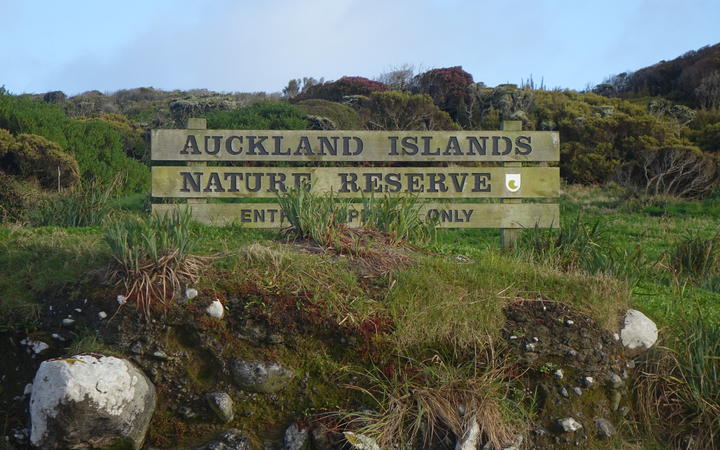
Miraculous survival in the Auckland Islands
After having researched and written the story of two nineteenth century wrecks on Auckland Island, my heart sank when the news arrived this morning that a rescue helicopter had crashed there. I felt no hope for the three men on board.
But, miraculously, the trio not only reached Auckland Island, but they were rescued from there.
From Radio New Zealand
Three helicopter crew members who survived a crash in the subantarctic ocean have made it safely back to the mainland.
The crew had been on their way to medically evacuate a person from a fishing boat when they crashed last night.
About 10.20am, Rescue Coordination Centre NZ said a fishing boat had found wreckage from the helicopter, later confirmed to be the door.
About midday, the men - two pilots and a St John paramedic - were found alive on a beach on Auckland Island, about 450-kilometres south of New Zealand, after more than 16 hours of being missing.
Late this afternoon, they arrived at Southland Hospital in Invercargill, where their condition will be assessed.Rescue Coordination Centre's duty manager Kevin Banaghan said he had heard reports that one of them may have minor injuries to his ribs.
A spokesperson for St John said the organisation was very pleased that the group was safe and now receiving medical treatment.
The spokesperson said the paramedic's family were hugely relieved and looking forward to being reunited with him later tonight.
Rescue Coordination Centre duty manager Kevin Banaghan said it was an outstanding result, and he was very pleased.
"The owner of the company, Richard Hayes, who's actually arrived down there as part of the rescue effort, actually arrived on scene and located the three crew walking around the beach in their immersion suits."
The crew were transported to Enderby Island at the northern end of the island group to seek shelter before returning to the mainland.
The missing helicopter crew were found walking on a beach in the Auckland Islands. Photo: RNZ / Ian Telfer
Earlier today, the centre's Mark Dittner earlier told Morning Report the last contact with the helicopter was at 7.37pm near Yule Island.
"The owners of the helicopter, Southern Lakes Helicopters, they realised that they hadn't had contact with the helicopter for a while and they informed the rescue centre at 8.15pm last night."
"We're currently trying to locate the helicopter, so we've got a P3 Orion from the Royal New Zealand Air Force using the specialised equip it has on board. We've also got five fishing boats on the scene," as he said at the time.
Mr Dittner said the helicopter - a long-range commercial aircraft, though the specific model was unknown - had been intended to airlift someone from a boat at the islands to Invercargill.
A brave rescue mission, fortunately without a tragic end.
Sunday, April 21, 2019
You could buy that hardback book for $15, but.....
![]() |
| Bookstore in Reno, courtesy Jacqueline Church Simonds |
It's an all-too-human trait, like the cruise ship passengers who come into our Wellington supermarkets, just to ooh and ahh about what we are charged for lettuces or chocolate or whatever.
But has anyone thought about the economic consequences of this casual behavior?
The proprietor of a bookstore did, after he became tired of watching customers check the prices of his stock, and then stomp off to buy the book on Amazon. Or whatever. He sketched out his justified anger in a tweet -- and was amazed when it went viral.
It even reached the august ears of the Chicago Tribune. And their roving reporter, Mary Schmich, wrote a story about it.
Danny Caine, who is 32, was sitting in the tiny office of his bookstore the other day when he heard a customer at the counter say something he hears a lot.
Listening to the clerk patiently try to answer the customer’s complaint, he stifled his reflexive frustration and decided to do something productive.
On the store’s Twitter account, he began to type:
“Today a customer mentioned that she could get a new hardcover book online for $15. Our mission is not to shame anyone for their shopping practices, but we do feel a responsibility to educate about what it means when a new hardcover is available for $15 online.”
He laid out some numbers.
“When we order direct from publishers, we get a wholesale discount of 46% off the cover price. The book in question had a cover price of $26.99, meaning our cost for that book from the publishers would be $14.57. If we sold it for $15, we’d make…43 cents.”
Tweet by tweet, he continued the math.
“We have 10,000 books in stock. If we sold every one of them with a 43 cent markup, we’d make enough to keep the store open for about six days.”
He also listed thoughts on how independent book stores strengthen communities. They create jobs and pay taxes. They offer author visits, open-mic nights, a place to hang out, store cats to pet and photograph, etc. He concluded:
“If you’ve ever wondered why it seems like ‘there are no bookstores anymore’ or why retail businesses keep closing in your downtown, this is it. A cheap book still has a high cost.”
Caine sent his words into the ether expecting they might be seen by a few of the 6,200 Twitter followers of The Raven Book Store in Lawrence, Kan. That was on Wednesday.
On Thursday morning he got up and checked his phone notifications.
“Oh my God,” he thought.
His initial tweet had been retweeted thousands of times, all across the country, by readers, writers and bookstores, including Chicago’s Women & Children First, which is how I stumbled on it while cruising for news of the Mueller Report.
It made me do a double take. A tweet from a little Kansas bookstore had stirred more reaction than most of the tweets about the day’s big news?
Want to read more? Hit the title of the newspaper to get the full story.I learned about it from a writer/publisher friend who works in a large bookstore in Reno, Nevada. "Every day, I hear, "Well, if you don't have it, I'll order it on Amazon." and I always think, hey, thanks for making sure 70 local people will be unemployed," she said.
"The internet has made people casually mean, ridiculously cheap, and value other humans less. There's no better place to witness this than in retail."
Thursday, April 18, 2019
Storm, shipwreck, gyro and GPS
A fascinating link between these four things is described by the BBC
On 5 October 1744, a storm was brewing in the English Channel. With sails set for home after chasing a French fleet off the coast of Portugal, a squadron of British warships was in trouble.
The lead ship HMS Victory sank 100m to the seabed 50 miles (80km) south of Plymouth, taking with it 1,100 men and - so rumour had it - lots of Portuguese gold. The wreckage lay undisturbed until it was located by a marine salvage company in 2009.
Beyond the rumoured gold, there was something else on board which was arguably much more economically significant.
Also lost that day was the first known attempt to develop an idea that is now used to guide everything from submarines to satellites, from rovers on Mars to the phone in your pocket.
When the Victory went down, it took with it John Serson's "whirling speculum", forerunner to the gyroscope.
Serson was a sea captain, and barely literate. But he was also an "ingenious mechanick", as The Gentleman's Magazine later put it.
He was trying to solve a serious problem.
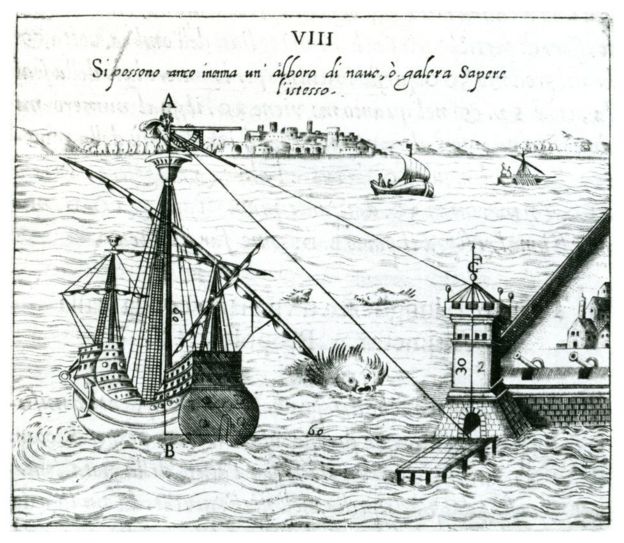
Sailors worked out a ship's position by using a quadrant to take an angle from the sun to the horizon, but you could not always see the horizon, because of haze or mist.
Image copyrightGETTY IMAGES
Inspired by a child's spinning top toy, Serson wondered if he could create an artificial horizon - something that would stay level, even as a ship lurched and swayed around it.
As The Gentleman's Magazine recounts, he "got a kind of top made, whose upper surface perpendicular to the axe was a circular plane of polish'd metal; and found, as he had expected, that when this top was briskly set in motion, its plane surface would soon become horizontal. If the whirling plane were disturbed from its horizontal position, it would soon recover it again".
After impressing two high-ranking naval officers and an eminent mathematician, Serson was asked to make further observations… aboard the HMS Victory: "and so perish'd poor Mr Serson".
His widow, Sarah Serson, was left penniless and asked the Navy for copies of his documents so she could try to make money from the speculum, although there seems to be no evidence that she succeeded.
However, a century later, French physicist Leon Foucault would produce a successful prototype based on the same principle which had fascinated Serson.
Image copyrightGETTY IMAGES
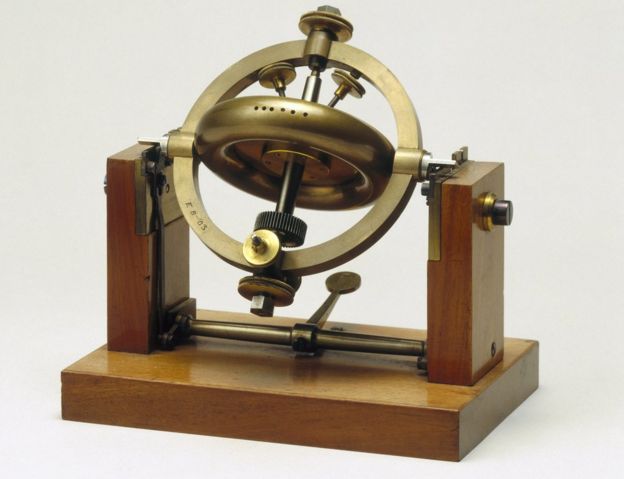
Foucault called his device a "gyroscope", from the Greek words for "turn" and "observe", because he used it to study the Earth's rotation.
It was a spinning disc mounted in gimbals, a set of pivoted supports that allow the disc to maintain its orientation regardless of how the base might be tilting around.
Then electric motors came along, meaning the disc could spin indefinitely. And practical applications came thick and fast.
Ships got workable artificial horizons and so did aeroplanes.
In the early 1900s, two inventors figured out how to align the spin to the Earth's north-south axis, giving us the gyrocompass.
Image copyrightGETTY IMAGES
Combine these instruments with others - accelerometers, magnetometers - and you get a good idea of which way up you are and in which direction you are heading.
Feed these outputs into systems that can course-correct, and you have an aeroplane's autopilot, a ship's gyro-stabilizer, and navigation systems on spacecraft or missiles.
Add in GPS, and you know where you are.
Subscribe to:
Posts (Atom)