Search This Blog

Sunday, January 1, 2017

Whales that have lost their prey

What does a predator do when the food source moves to a different locality?

Follows it, of course.  And this, it seems, is what has happened to the sperm whales of Kaikoura, New Zealand.

As the world knows, perhaps, Kaikoura has recently been the hub of a 7.8 earthquake, which involved a series of faults.  And one of the affected places was the trench off Kaikoura, where giant squid live, and young sperm whale bulls congregate to learn to socialize, and incidentally to feed off them.

GIANT UNDERWATER LANDSLIDE IN THE KAIKOURA CANYON

As well as triggering tens of thousands of landslides on land, the magnitude 7.8 Kaikōura earthquake also caused a massive underwater landslide.

It moved down the deep canyon system that lies just offshore, generating a turbulent turbidity current of mud, sand and water that was detected more than 300km away, off the coast of Hawke’s Bay.

The continental shelf around the headwall of the Kaikōura Canyon is just 30m deep, but the steep-sided 50km-long Kaikōura Canyon quickly drops to 600m. It continues to deepen until it is about 2000m deep where it joins the Hikurangi Channel.

This channel, which is also fed by the Cook Strait Canyon, is a long meandering abyssal river. It flows for several thousand kilometres, up the east coast of the North Island, eventually emptying all the sediment into a large fan in the South Pacific Basin.

This massive underwater canyon and river system is like several Grand Canyons flowing into a river like the Mississippi.


When the Kaikōura earthquake occurred, the NIWA research vessel Tangaroa was already at sea, studying the Hikurangi subduction margin off East Cape. This is where the Pacific tectonic plate dives beneath the North Island, which lies on the Australian Plate. It’s considered to be New Zealand’s largest earthquake and tsunami hazard.

Scientists on board were stunned by what they found.

“Lo and behold there was a sea of mud down there. There is still mud and clay falling out of the water column and it’ll probably go on for days or weeks or even months. We’ve got about 10 centimetres of sand and silty sediment already on the seafloor now. That is about 300 kilometres away from where it must have been sourced from.”

The sediments on the floor of the Kaikōura canyon are remarkably rich in life. Earlier research by NIWA identified it as a hotspot of benthic biomass, and “one of the most productive habitats described so far in the deep sea".

And, while the report doesn't mention it, this biomass includes giant squid and sperm whales.

What is interesting is how the event may have affected these two creatures.

Most unusually, sperm whales have been seen congregating to the north, near Nelson.

A dead one has been washed on shore ... dead of some unknown cause.


Residents in north Nelson reported seeing large whales in the bay yesterday, which were initially thought to be either humpback or right whales.

Otago University zoologist and researcher Liz Slooten said it looked very much like a sperm whale, judging by footage posted on social media.

The carcass of a sperm whale washed up on the beach this morning.

People on the beach said early this morning it appeared that several whales were offshore trying to reach it.

Did seismic research cause the disorientation of the pod, and the subsequent death of this one?

That's one theory.

The scattering of the giant squid population caused by the underwater landslide is another.

With thanks to Dr Brian Easton, who alerted me to this interesting development


Saturday, December 31, 2016

New Zealand and Israel -- the threats and repercussions

New Zealand might be a featherweight country, but...

From RNZ news

A UN Security Council resolution, calling for a ban on illegal Israeli settlements in the occupied territories, has passed, with NZ taking a major role. Phil Smith outlines the background and the blowback.

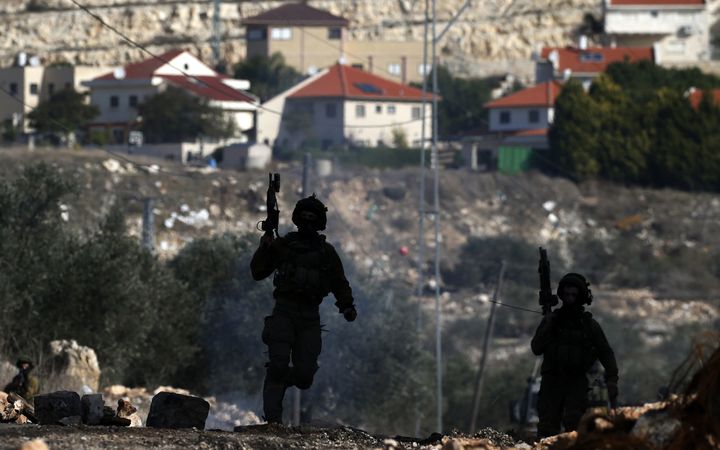
Israeli security forces taking position near the settlement of Kadumim (background) during clashes following a demonstration against the expropriation of Palestinian land by Israel.
Israeli security forces taking position near the settlement of Kadumim (background) during clashes following a demonstration against the expropriation of Palestinian land by Israel. Photo: AFP
 
New Zealand has dared to go where even Egypt's strongman, President el-Sisi, feared to tread. Abdel Fattah el-Sisi put a forward a resolution demanding an end to Israeli settlement building, but after an incredibly inappropriate call from Donald Trump, el-Sisi withdrew it again. Exactly how Trump achieved that is anyone's guess, but America's $1.5 billion aid package to Egypt may have been threatened.

President el-Sisi said he wanted to let Trump's incoming administration have first crack at the issue. It was obviously an excuse. Trump's nomination for Ambassador to Israel is a hardliner who wants more settlement construction and who has compared Jews who advocate for a 'two-state peace' to Capos (Jews who assisted in Nazi death-camps).

Amr Abdel Latif Aboulatta, Permanent Representative of Egypt to the UN, votes in favor of the ban on Israeli settlements.
Amr Abdel Latif Aboulatta, Permanent Representative of Egypt to the UN, votes in favor of the ban on Israeli settlements. Photo: AFP

When el-Sisi retreated, New Zealand stepped up. Together with Venezuela, Malaysia and Senegal, New Zealand called for a vote on the resolution, and for the first time since the Carter administration, the US declined to veto a rebuke over illegal Israeli settlements.

The US noted that settlement construction had accelerated since the US vetoed a similar resolution in 2001, and that the Obama administration has been warning Israel for eight years that this 'trend-line' was both making peace more difficult and isolating Israel from the international community.


The foundations of the settlements

Settling population in militarily-occupied territory is contrary to the Geneva Convention, to international law and previous United Nations rulings.

Settlement building is usually strategic. Settlements create 'facts-on-the-ground', making it more difficult to give back captured territory (in this case, territory captured during the 1967 Six Day War).

Hardliners believe the territory is theirs by God-given right, but its return, at least in part, would be necessary for a lasting peace based on a two-state solution. The tracts that are currently Palestinian controlled areas are an unworkable, disconnected patchwork of territories.

Settlements also increase local conflict by expropriating land and resources to construct and sustain the townships. Moderate Israeli administrations have tended to restrict or demolish settlements, while hawkish governments look the other way, or - like the current one - are gung-ho on expansions which push Palestinians into an ever-diminishing corner.

Israel Prime Minister Benjamin Netanyahu has declared his country would not abide by a new UN resolution.
Israel Prime Minister Benjamin Netanyahu has declared his country would not abide by a new UN resolution. Photo: AFP
 
Former US President Jimmy Carter has repeatedly stressed that peace in Israel/Palestine is only likely when the Palestinians also have a viable state, where middle class citizens have a reason to hope and work for a future. Some form of two state solution has been American policy for decades.

Seeing this may be about to change, and after significant antagonism from Israeli PM Benjamin Netanyahu, President Obama apparently believes it is time to allow a line in the sand.


Kiwi peace-broker

A few years ago, after the successful Bougainville peace talks, New Zealand imagined a role for itself as an international peace broker. It was a nice idea that turned out to be harder than it sounded, but it marked an increased New Zealand confidence to act independently, for good purpose.

This week's action is a further brave step from New Zealand. It has no obvious ulterior motives, but instead seems an attempt to simply do the right thing and bugger the consequences. A nation like New Zealand cannot throw its feather-weight around internationally in order to win friends.

Frequently, the opposite is achieved. A friend won with one action is alienated with the next, and nations often remember slights more strongly than support.


The blowback

The blowback has already begun. Israel is apoplectic and has recalled its envoys to New Zealand and Senegal, and stopped its Senegal aid programme. It called the resolution "despicable" and "an evil decree". The Israeli Ambassador to the UN said the vote was "a victory for terror, a victory for hatred and violence."

New Zealand was already in Israel's bad books. In 2014 Israel refused to accept New Zealand's ambassador because he was also to act as an envoy to the Palestinian Authority. In October 2015, Israeli officials reprimanded our Ambassador after New Zealand dared propose a Security Council resolution that dared encourage a return to peace negotiations. Palestinian supporters were equally upset, seeing the wording as supporting Israel.

Foreign Affairs Minister Murray McCully chairs a meeting of the UN Security Council.
A meeting of the UN Security Council Photo: RNZ / Jane Patterson

But this time is worse. Israeli-New Zealand relations haven't been so poor since 2004, when New Zealand imprisoned 'Mossad spies' for attempting to fraudulently obtain a New Zealand passport.

After a year, Israel apologised and relationships were slowly mended.

This new rift may take longer. Much of the anger is being directed at the US, where President Obama could have chosen to veto the resolution. But Netanyahu's conservative government will not take kindly to us fronting a resolution that pointedly calls East Jerusalem "occupied Palestinian territory".
New Zealand's government will have known blowback was likely. It has decided that, if you ask to be on the Security Council you need to appear from behind the parapet and take a stand.

In an era where the world's mood seems to be trending towards resentment, aggression and extremism, a country wins few friends by calling for tolerance or asking for restraint. But that doesn't mean that working for peace and goodwill isn't the right thing to do.

Sunday, December 25, 2016

Alaric Bond's Latest

Great review from Historic Naval Fiction

The Blackstrap StationFollowing the wreck of HMS Prometheus, some of the crew have managed to evade capture and a British Frigate is nearby. When their attempt to steal a vessel coincides with a cutting out attempt, action and new responsibilities follow for Tom King. Now based in Malta with a shore job he worries that  his seagoing career will be over.

Another well written narrative from Bond with sea action and some nefarious shoreside activities which as usual follows a wide cast of characters from all ranks as well as some civilians, all of whom you feel you know. The plot had plenty of unexpected twists which made it hard to put down.

Bond's historical accuracy, knowledge of sailing ships and characterisations imerse you in the period and he continues to be one of the best contemporary naval fiction authors. Highly recommended.

Thursday, December 22, 2016

Frederick Douglass, the most photographed American of his time

A long time ago, I was in Los Angeles researching the experiences of runaway slaves on New Bedford whaling ships.  It was for background to my book In the Wake of Madness, the troubling story of a homicidal whaling captain, who beat his steward, a young runaway slave, to a slow and agonizing death.  And, while consulting with Kathryn Grover, the author of The Fugitives' Gibraltar, Escaping  Salves and Abolitionism in New Bedford, Massachusetts, I became intrigued with one of the most famous runaway slaves of all, Frederick Douglass.

He became my hero.  In short, I needed a copy of his memoir, Narrative of the Life Of Frederick Douglass, an American Slave, in a hurry.

Friends dropped me at what must be the largest pre-loved books store in the world, at Long Beach.  It resembled an aircraft hangar.  Maybe it was an aircraft hangar.  In the doorway, there was a small desk, with a young man who appeared to know where all the books were.  A dim, shadowy vastness stretched behind him.

I asked for Black History.  He directed me to the farthest, darkest corner, which felt, I swear, a mile away.  And as I threaded my way through the loaded shelves, I realized I was being trailed by four young Black men.

When I stopped, having found the right section, they stopped.  I turned.  We all looked at each other.

I said, "Can I help?"

One young man said, "We just want to know why a white lady like you wants to read about Black men like us."

So I told them about Frederick Douglass.  They had never heard of him.  They were enthralled.  Then, when I had finally finished, they thanked me very politely, and went away.

I've thought about that often, wondering if learning something about this American hero had any effect on their lives.

Today, I was reminded of it.  The New York Review of Books, in its review of the best articles of the year, includes a discussion of two books about "the Mysterious, Brilliant Frederick Douglass".

It begins:  Some years ago, after giving a talk at a college in Louisiana, I was approached at the podium by a middle-aged white man who said, with a genial smile, “Since you mentioned Frederick Douglass, I thought you’d be interested that my family used to own him.” His matter-of-factness was a shock to this Yankee clueless in Dixie. I couldn’t tell if I was meant to congratulate or, perhaps, commiserate, as if his forebears had misplaced some rare collectible. So I said something lame like, “Well, that’s quite something, thanks for letting me know.”

Wow.  That's quite something.  Was the man proud of being a descendant of the man who had owned this hero?   I don't know how he felt, but I have a good idea of how the writer felt, having had much the same experience when I met the very polite and pleasant descendants of the homicidal whaling captain.

But that is another story.


Thursday, December 15, 2016

And what about the rabbits?


Author of To Sir, With Love dies at 104


To Sir, With Love author ER Braithwaite dies aged 104

Author whose autobiographical novel dramatising his time as a black teacher
in east London in the 50s had a career that took in social work and
diplomacy as well as writing

Danuta Kean

Wednesday 14 December 2016 11.55 GMT

ER Braithwaite, the Guyanese author of To Sir, With Love, has died at his
home in Maryland at the age of 104.

Born in Guyana on 27 June 1912, Eustace Edward Ricardo Braithwaite was the
child of privileged parents, both graduates of Oxford University. His father
was a diamond miner while his mother raised the family. During the second
world war, he joined the Royal Air Force to fight as a pilot before going on
to Cambridge to read physics. He later said that he experienced no racial
prejudice within the RAF.

On graduating, he found himself barred from work as an engineer because of
racism. Unable to find an alternative, he took a job as a teacher at St
George-in-the-East school in London¹s East End, which was recovering from
the battering it had taken during the war. This experience formed the basis
of his autobiographical novel To Sir With Love, his 1959 book later adapted
into a film of the same name starring Sidney Poitier.

At the school, renamed Greenslade School in the film, the well-educated
middle class graduate was confronted with casual racism, violence and
antisocial behaviour by a group of disadvantaged pupils. Hardest to bear was
the self-hatred the racism brought out in him and the low expectations of
colleagues for their charges.

Gritty and unsentimental, the book shows Braithwaite gradually turning his
class around through a mix of affection and respect. It also revealed his
love affair with a fellow teacher ­ controversial at the time because the
other teacher was white. When the film adaptation was made in 1967,
Braithwaite criticised it, saying the love affair had been downplayed.

The book also contrasted his experience of race relations in Britain with
those in the US, where he studied before joining the RAF. He wrote: ³The
rest of the world in general and Britain in particular are prone to point an
angrily critical finger at American intolerance, forgetting that in its
short history as a nation it has granted to its Negro citizens more
opportunities for advancement and betterment, per capita, than any other
nation in the world with an indigent Negro population.²


To Sir, With Love has been hailed as a seminal work for immigrants from the
colonies to postwar Britain. In an introduction, Caryl Phillips wrote: ³The
author is keen for us to understand that the Ricky Braithwaites of this
world cannot, by themselves, uproot prejudice, but they can point to its
existence. And this, after all, is the beginning of change; one must first
identity the location of the problem before one can set about addressing
it.²

After teaching, Braithwaite moved to social work, finding foster homes for
children of colour. This formed the basis of for his 1962 book Paid Servant:
A Report About Welfare Work in London. He went on to write a further nine
books, a mix of novels, short-story collections and memoir.

A visit to apartheid South Africa in 1973, following the country lifting its
ban on To Sir, With Love, resulted in Honorary White (1975). The title was a
reference to his visa status, which granted significantly more privileges
than enjoyed by the native black population. The book had a mixed reception:
one critic described it as too soft on the apartheid regime, too hard on the
oppressed black population and too focused on the author.

After his social work, he moved to Paris to work for the World Veterans
Association, before transferring to Unesco and a diplomatic career that took
in posts as permanent representative of Guyana to the UN and Guyana¹s
ambassador to Venezuela.

From diplomacy, he moved into academia, teaching at the universities of New
York, Florida State and Howard in Washington, where he also served as
writer-in-residence.

When asked in 2013 whether he had stayed in touch with students from the
London school, he admitted he had not, telling the Coffee Table blog: ³I
don¹t know if I changed any lives or not, but something did happen between
them and me, which was quite gratifying.²

Braithwaite¹s companion, Genevieve Ast, confirmed his death on Tuesday. He
died a day after being admitted to a medical centre in Rockville, Maryland.


© Guardian 2016

Monday, December 5, 2016

New Zealand and its Faults

From Geonet


Kekerengu Fault has a Word to its Geologists


Written by Ursula Cochran

Last year Tim Little of Victoria University of Wellington and Russ Van Dissen of GNS Science thought it would be a good idea to find out more about the Kekerengu Fault in North Canterbury. Through previous work they had identified the Kekerengu Fault as likely to be the fastest slipping fault within 100 km of Wellington city apart from the Hikurangi subduction zone.

They knew this meant it posed a significant seismic hazard to the northeastern South Island and also to Wellington if linking faults in Cook Strait ruptured at the same time as the Kekerengu Fault.
In February of this year, with funding from the Natural Hazards Research Platform, Tim and Russ excavated three trenches across the Kekerengu Fault to look for evidence of past large earthquakes. The main aim of their project was to better constrain the seismic hazard posed by this major active fault.

In these trenches Tim and Russ found evidence that at least three past large earthquakes had occurred in the last 1250 years. These initial results confirmed that the Kekerengu Fault was capable of producing large earthquakes frequently (on average, about every 300 or 400 hundred years), and was likely to do so again in future.

Then, two weeks ago, as if to say, “Don’t underestimate me!” the fault ruptured right through those same trenches. Tim was awe-struck. As a geologist working on active faults he said, “I had often wondered what it would look like if a fault moved while we were working on a trench cut across it, but I had never expected this to happen to me.”

When the Kekerengu Fault moved as part of the M7.8 Kaikoura earthquake the impacts on the landscape were dramatic. One side of the fault has moved as much as eleven metres with respect to the other side. Tim did not expect quite this amount of slip on this fault during a single earthquake. Russ, though, was less surprised – he says it fits with the long-term slip rate calculated for the fault – but he is still amazed to see such fault movement in action.

So, we knew about this fault, we knew it posed a seismic hazard, we even thought it was possible that it would rupture jointly with other faults – New Zealand’s National Seismic Hazard Model specifically includes scenarios that involve joint rupture of the Jordon, Kekerengu, and Needles Faults. And this, now confirmed by NIWA’s offshore survey of the Needles Fault, is exactly what happened on Monday 14th November. What we had not foreseen is that even more faults would be involved in a single earthquake sequence.

Currently we have evidence for seven faults rupturing in the M7.8 Kaikoura earthquake so work on the Kekerengu Fault is just a small part of the earthquake geology response. There are teams from University of Otago, University of Canterbury, University of Auckland, Victoria University, GNS Science, and NIWA, not to mention volunteers from overseas, currently mapping and measuring the faults that moved last week. We want to understand what happened in this event but, most importantly, what it means for future events.

The Kekerengu Fault has been speaking to geologists-in-the-making for generations because Victoria University’s third year structural field geology course is held near its northern end. I still clearly remember the Kekerengu Fault back in the early 1990s as a subtle, curious line in the landscape that our professor – Tim Little – stood astride inciting us to notice. Today, the fault has spoken and it is impossible not to notice.

Tuesday, November 29, 2016

Happy Birthday Maritime History Discussion List


All kinds of exciting maritime events happened in Canada on 29 December ....

November 29 RCN News Magazine Today in History

1943 - Frigate HMCS Montreal arrived Halifax from builder Montreal PQ
1943 - Corvette HMCS North Bay arrived Halifax from builder Collingwood ON
1943 - HMCS Mayflower, a Flower-class corvette, commenced a refit at Norfolk
VA. Many Canadian and British warships were repaired and refitted in the US,
and at Norfolk in particular. British and Canadian shipyards were overloaded
with repair work, to the detriment of many new construction programs.
Chronic shortages of new technology items in Canada also dictated that much
upgrading work had to be done in the US or in the U.K. At a time when the US
was producing modern destroyer-escorts at the rate of one every 20 days and
with manning shortages for newly constructed Canadian warships reaching
crisis proportions, putting such effort into refitting a ship of marginal
value was, to say the least, questionable
1944 - Frigate HMCS Sussexvale commissioned
1944 - Destroyer HMCS Qu'Appelle arrived Pictou NS for refit
1944 - Tug HMCS Johnville assigned to Gaspe PQ
1944 - Frigates HMCS Saint John, Stormont, Port Colborne, Nene, Loch Alvie,
Monnow departed Loch Ewe with Convoy JW-62 for Kola Inlet
1945 - Frigate HMCS Coaticook paid off Esquimalt BC
1957 - Minesweepers HMCS Kentville, Nipigon, Fort William, Medicine Hat,
Kenora sold to Turkey under the US-funded NATO MDAP program. After refits in
Sydney NS, the ships were renamed Bartin, Bafra, Bodrum, Biga, and Bandirma
respectively
1985 - Destroyer HMCS Restigouche completed life extension refit Esquimalt
BC
1990 - United Nations Security Council approves resolution authorizing use
of military force unless Iraq vacates Kuwait by 15 January 1991
1994 -
http://www.marmuseum.ca/index.php/research/marhst-l-research-resources
established by the Marine Museum of the Great Lakes with the assistance of
Queens University Kingston ON

I joined the List that year, when dial-up and charges-by-the-moment were the usual thing.  There was no FaceBook, no Twitter, no easy links to maritime history -- if those links existed at all.  I still remember the excitement as the link to what we affectionally called "MarHist" worked through, and I waited to see what the wise answers to my latest question might be.

There are a lot of wise people on this list, mostly men, and invariably helpful and polite.  The membership has gone up ... and down, as other sites have competed for attention.  But there is still a core of loyal members.  Happy birthday to their participation, particular good wishes to the two  hardworking moderators, Walter Lewis, and Maurice Smith, and a bow to the generosity of the Queens University in Kingston, Ontario.

Raise a glass! 

Sunday, November 27, 2016

Controversial Poldark


For those who have not yet seen episode 7 of season 2, be warned that this post has spoilers

A Hot Sex Scene in the hugely popular historical drama series "Poldark" has the commentators hopping.

Most intriguing of all, perhaps, is that the American version of the Hot Sex Scene is different.  The controversial bit has been removed, though with what effect is debatable and dubious.

To provide the background, I can do nothing better than paraphrase from the racy roundup on the WETA television blog, the commentary Recapping Poldark.

The Vile George Warleggan, villain of the story, has talked Elizabeth (Ross's ex-fiancee, and the widow of his cousin, Francis) into agreeing to marry him.  And instead of manning up and informing Ross in person, Elizabeth sends him one of those Austen-style letters, announcing her decision.

Ross is in a foul mood already, much of which he has taken out on his long-suffering wife, Demelza.  He had had a nasty day at the mine, involving the collapse of a tunnel, and the death of three men, and late at night is a bad time to open a letter like this.

He announces he is off to see Elizabeth, presumably to talk her out of this disastrous marriage, even though he has no kind of alternative to offer. Demelza begs him not to go, begs him at least to wait until the next day, but he’s just angry that she didn’t tell him about her suspicions this was happening. He tells her to get out of his way.

Ross barges right into the house at Trenwith. He literally kicks a door down. (Seriously?  In the book, he jumped in a window.)  He confronts Elizabeth, refuses to leave when she asks him to and declares that she can’t marry George. I think this is supposed to be Ross being heroic – trust me, I don’t want Elizabeth to marry Vile George either – but he just comes off as bullish and jerky.  (This opinion, from the WETA blogger, is one that I agree with wholeheartedly -- but it must have been a hell of a part to play.)

As the blogger goes on to say, no one could even start to guess what Ross  expected Elizabeth to do. Despite his poor treatment of poor Demelza, he's made no plans to up sticks and leave her. Is Elizabeth just supposed to stay alone forever, and be nobly poor, and take care of her sick mother and raise her son, and eat stale crusts of bread forever, all alone? All so that Ross doesn’t have to make any decisions or do anything that might inconvenience him or actually deal with his own emotions?

Apparently so.

Ross even has the gall to accuse Elizabeth of marrying George for his money. (Seriously!)  She denies it in a huff, of course – but so what if she was? She has a small child and a sick mother and no one else to help her. People make compromises all the time, and if she can live with marrying the vilest person in the county in exchange for some comfort and safety, I’m not sure why Ross thinks he gets to judge her.

And then the scene gets really difficult.  Ross grabs Elizabeth and kisses her. She shoves him off and he says she can’t love George. She says she sure does, and it’s clearly a spiteful lie, but he grabs her and kisses her again and she cries, "No!" but next thing you know they’re in bed and having sex, despite how furious and resistant everyone seemed to be a minute ago.

Now, my commentary.  My first reaction was that this was the old, tired, distasteful story.  The girl says no, but when the man persists, she finishes up enjoying it.  In a word, when she said no, she didn't really mean it.  How many times has that feeble excuse been made?

My other reaction was that it seemed very dated.  It took me back to that deathless movie, Gone With the Wind, and the scene where Rhett Butler gets sick and tired of Scarlett (who is his wedded wife at that part of the story) constantly refusing his attentions.  So he grabs her and rapes her.  Bad enough.  What was really shocking was the next scene of her waking joyously in bed.  Yes.  Seriously.

But back to Poldark.  Was it in the book (number three in the series, titled Warleggan)?  Yes.  The scene was played as written.  Perhaps the actors could have diluted what was obviously going to be controversial by having Elizabeth sigh her "No," instead of shouting it.  Then consensual sex would have been easier to comprehend.  After all, the pair have been lusting after each other forever.  But she definitely snapped out that fatal little negative.

The British public certainly reacted.  The tweetosphere ran hot, it seems.  The Radio Times responded with a scholarly comparison of the passage in the book with the TV scene, along with interviews with Debbie Horsfield – creator of the new series – Aidan Turner, who plays Ross Poldark, and Andrew Graham, son of the author.

The Telegraph ran an analysis -- was it rape or was it not? -- along with comments from a women's campaign group saying it sent the worst possible message.

The Guardian agreed that it was certainly not OK, and compared it to the appalling rape scene in Sam Peckinpah's Straw Dogs, adding a description of a rape scene in a Royal Opera House production of William Tell that I, as an opera addict, found horrifying.  Quite frankly, I found the comparisons over the top, with an unintended result -- making the rape (if it was a rape) of Elizabeth seem relatively insignificant.

The BBC News, as is proper, merely reported the controversy, along  with a rather startling comment from the author's son, Andrew Graham, saying, "There is no 'shock rape' storyline in the novels.To say so is to misconstrue my father's text. The BBC has cut nothing and Mammoth Screen's portrayal of these scenes is entirely true to my father's writing."

The BBC had received 17 complaints about the scene at the time of writing, or so the news reports.  Seven of these were formal notifications to the media regulator, "Ofcom."  Undoubtedly, some kind of decision will be forthcoming.

But what about the American version of the episode?

In this one, the whole section after the first rough kiss is cut out.  The kiss bit segues into the next morning, where Elizabeth is lying serenely in bed watching Ross get dressed, ready to ride out and confront his understandably furious wife.  This, to put it mildly, must have left the audience puzzled.  What the hell happened?  Did Elizabeth return the kiss, so that she becomes the seductress, and Ross, somehow, remains a heroic figure?  Or did they simply talk the nighttime hours away?

As the WETA blogger says, it just doesn't feel right to take such an important part of the story away --  The decision to alter the scene for American broadcast feels odd….if the showrunners want to make it clearer that Ross and Elizabeth finally gave in to their life-long passion instead of something darker. Or if they wanted to make sure Ross stayed at least partially heroic. Or both. Maybe the folks in charge just didn’t want to end up in another media/critical firestorm about rape as a plot device.

And I agree with him (or her). Though the decision to delete might have felt wise, nonetheless it is basically dishonest, cheating not just the audience, but the writer and screenwriters, too.


Friday, November 25, 2016

The original cliffhanger


I adore my digital radio.

I can listen with perfect sound to any of thousands of radio stations throughout the world.  Apart from National Radio New Zealand, where I catch the local news and commentary, my favorite is WETA Classical, broadcast out of Washington, DC.

It is Thanksgiving Day over there, and the last day of their annual Classical Countdown, where they play listeners' choices, in order.  We have something similar here in New Zealand, at New Year, but I listen to it only out of curiosity, as they play frustratingly short extracts of each selection.  WETA Classical, bless them, play the whole of each and every wonderful piece.

Beethoven features prominently -- and I wonder if Number One will be the Choral Symphony, (symphony number nine), as it was last year.  So far I have heard two symphonies, the deathless Moonlight sonata, and the lovely chamber trio, all with places in the one hundred.  Symphony Seven was Number Five in the popularity poll.

Number Three, somewhat to my surprise was Rimsky-Korsakov's Scheherazade.  When I meditated aloud that it was a bit of an old warhorse, Ron said he likes it.  And, obviously, thousands of American listeners share his taste.

And I shouldn't deride.  The tunes are good, and the lady it commemorates was the originator of the cliffhanger.

We all know the story as The Thousand and One Nights, or, more simply, The Arabian Nights.  How a Sultan by the name of Shahryar was betrayed by an adulterous wife, so, after slaying her, he vowed to sleep with a virgin each night, and slay the poor lass next morning, to make sure it never happened again.

Then, he encountered the vizier's daughter.  Scheherazade.  And the arrangement for the fatal night was made.  But Scheherazade had a strong and unusual sense of self-preservation.  As the translator, Sir Richard Burton (not the actor), put it:

"Scheherazade had perused the books, annals and legends of preceding Kings, and the stories, examples and instances of bygone men and things; indeed it was said that she had collected a thousand books of histories relating to antique races and departed rulers. She had perused the works of the poets and knew them by heart; she had studied philosophy and the sciences, arts and accomplishments; and she was pleasant and polite, wise and witty, well read and well bred."

And she plotted how to put all this lore to good use.  She begged the favor of the presence of her beloved sister, Dunyazade, in the bed chamber, and Dunyazade was prompted to ask Scheherazade for a bedtime tale.  And as the sultan listened to the yarn, he became engrossed.  In modern parlance, it was a page-turner. But then, in the middle, at the most exciting part, Scheherazade stopped.  She would finish the story, she said, the next night.

And so her life was spared until dusk fell again.  Prompted by both the king and her sister, Scheherazade finished the yarn -- and then started another one, which she left incomplete in just the same way.  And thus 1001 nights passed, during which time the sultan had fallen in love.   He married her, and made her his queen.  And so ends the tale of the Arabian Nights

And the cliffhanger was introduced to literature, along with Sindbad the Sailor, flying carpets, and bottled genies.

Did Scheherazade really exist? Unfortunately, not.  Her story is a frame for a collection of tales, gathered over many centuries by storytellers over Asia and North Africa.  But the wise lady lives, in literature, lore -- and music.