Search This Blog

Sunday, September 25, 2022

Ruth Ware's The IT girl


No, not internet IT, but IT from the swinging Charleston era, when the IT girl had everything, the beautiful and rich sex kitten supreme.

And April had IT all -- until someone strangled her ....

Ruth Ware is a clever, clever author. I love the way she entwines other books -- classic books -- into her plot development. Rebecca, Turn of the Screw, and so forth.

I assume that this one is based on the classic play by Euripides, Medea.  The author gives this away quite early on. The main character -- April, the victim of the murder -- definitely echoes the mythic queen. Blessed by the sun, with magical qualities, and yet murderously inclined. April is all of that, beautiful, rich, entitled, glamorous, and yet vicious. She doesn't quite kill, but she plays really vicious practical jokes on her victims. So well portrayed that after just a few chapters I was willing to give a medal to whoever topped her.

But who was it? That is the mystery. And it is a good mystery, too. I didn't guess the murderer, and enjoyed the surprise.

Apart from April, though, the characters were tenuous. Hannah, the other main protagonist, was so one-dimensional and crippled with angst that I couldn't understand why her saint of a husband put up with her. The others were even more sketchily drawn, but as bit players in this very Greek drama they served their purpose.  

I found the BEFORE/AFTER format irritating. Halfway through, I contemplated reading all the BEFORE chapters and then the AFTER ones, but that would have meant I lost track, so I bore with it.

And, because Ruth Ware is now classed as a bestselling author, the editing isn't there. Awkward sentences kept popping up to spoil the tempo. And why this fashion for "like" instead of "as if"?

But I do recommend this book, and will keep following the author.

Saturday, September 3, 2022

Haunting wildlife image a big winner


A confronting photograph of a humpback whale carcass and circling sharks on the ocean floor in Coral Bay, Western Australia has won the Australian Geographic Nature Photographer of the Year competition for 2022. ‘Nature’s Prey’ by Ashlee Jansen captures a harsh act of Mother Nature, but an important part of the natural ecosystem.

Based in Western Australia, Ms Jansen captured this winning shot in July 2021 after a sub-adult whale died while making the annual migration north along the Ningaloo Reef.

The judges were united in selecting this powerful image as the overall winner and praised Ms Jansen’s photography skills.

“The beauty of the image lies in its artful circular composition, seen in the curves of the whale’s skeletal ribs mirroring the patterns in the sand, keeping our eye within the frame moving between the living and the dead,” they said.  

Image: Nature's Prey, by Ashlee Jansen, Overall Winner 2022 Australian Geographic Nature Photographer of the Year.

Friday, September 2, 2022

The ghost with the dancing horse


HIGH PLAINS DRIFTER

I have been watching Clint Eastwood since the age of about twenty, starting with "Rawhide."  It was the era of westerns, and I never tired of horse operas.  Perhaps it was because I'd had an after school job of ushering at a movie theater and westerns were standard fare.  And Clint was among the best of them.

So I kept on following, through the spaghetti westerns to Dirty Harry and then his self-directed films, and never tired of watching Clint Eastwood playing Clint Eastwood.  That lean, laconic, stone-faced style, so oddly attractive.

This film was made ages ago, in the seventies, but somehow I missed it. And this one is different.  Well, Clint plays Clint, just as he always did, but the story has a most unusual message.  

If you want revenge, take care not to sup with the devil.

Clint, playing a nameless stranger, rides into a small mining town, the usual western outpost with clapboard houses, a stable, a church.  A few of the local men accost him and threaten his life.  Predictably he proves himself -- with a gun, naturally.  So impressive is he that the townsfolk propose a contract.  They need a gunfighter, as three men they put away for murder are coming out of prison next day. The anonymous guy with a gun accepts it, but on his own very strange terms.  He has a mission of his own.

That mission is gradually revealed as he arms the townsfolk, drills them into a faint semblance of efficiency, and literally paints the town red.  His motives come in horrifying glimpses that leave the viewer to make his or her own conclusions.  Because of this, the ending is both thoughtful and satisfying.  As a western, this film is remarkably intelligent.

But the star of the show?  Not Clint, believe it or not.  It's Clint's equally nameless horse.  The dance as the gunfighter rides into town is startlingly clever.  That horse was so good, in fact, that I was on tenterhooks throughout the rest of the film in case that lovely, graceful steed was stolen, killed or hurt.

Scan through the credits of the clip above, and at three minutes into it, turn up the music and watch that horse dance.

Thursday, August 25, 2022

A Gothic from Tess Gerritson


***    

THREE STARS

Alcoholic food writer, Big cat. Haunted house. Ghost of a long-dead sea captain that is seriously sexy. Demons. Ghostbusters. Cute Maine coastal town. What more do you want?

But just three stars.

I picked up this book as I much prefer Dr. Gerritson's standalones, as they seem to have more thought and research behind them. So, as as maritime historian who is also a technical editor for maritime novels, I found it irritating that she had not researched the seafaring history of her home state, Maine. 

Ship names do not have the word "the" in front of them, and if they do (editorial choice?) the preposition should not be in italics. The sentence describing a "Down Easter" as "a three-masted sailing ship, 250 feet long, 44 feet wide, [weighing] a little over two tons" is so ridiculous it is hilarious. Even if the "two tons" is a typo, the vessel being described is more likely to be a clipper. 

Down Easters were in the California trade, clippers were more likely to be in the Oriental trade. And a crew of thirty-five? For a ship that size? Whaleships needed big crews for various technical reasons, but freighting sailing ships had very small crews, the owners being stingy. Captain "Shotgun" Murphy of Searsport, Maine, who commanded real Down Easters, would have a belly laugh at that.

But still, despite this serious caveat, I liked the book. There seems to be a fashion for emulating Daphne du Maurier (see Ruth Ware's The Death of Mrs. Westaway) which is no bad thing at all. The introduction of 50 Shades-type rubbishy B&D sex was a pity, as it is an entirely different genre, but on the whole this book as a shade of Rebecca wasn't bad at all.

It's no kind of mystery. Ava's dark secret was far too easy to guess, and wasn't all that terribly criminal, and the ending didn't reveal anything unexpected. But as a Gothic, yes, give it a go.


Friday, April 1, 2022

New Bacchante book and half-price promotion


JUST PUBLISHED

Storm Swept, the second in the Bacchante series.

Harold Pcderson’s discovery ships are in trouble. Specializing in exploring remote estuaries and photographing endangered wildlife in South East Asia and the western Pacific, his fleet ventures into waters that are rife with pirates.

When Jerry Giacomo is hired by Pederson to make his ships look bullet-proof, he finds that the situation is even more precarious than expected. The Jihadist breakaway group Abu Sayyaf is operating in the South China Sea, and their brutality is notorious, with filmed beheadings as well as outrageous ransom demands.  Because of the threat the terrorists present, Storm Swept, with all the Bacchantes on board, is requisitioned by the British navy, to take part in an exercise up a remote river in Borneo, where the pirates have their lair.

At the same time, Helen Pederson is trapped in a remote village in Mexico, being blackmailed by her first husband. When she mnages to confide her dilemma to Jerry and Skye, the Bacchantes are forced to face yet another great challenge. The paternity of the girls has been brought into question yet again.

And the answer could be fatal.

And -- to celebrate the publication of Storm Swept, for the month of April Daughters of the Storm will be half-price on all platforms except Amazon (which won't let me do it).


Monday, March 28, 2022

Amazing expedition, amazing goal


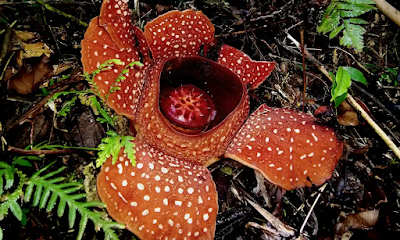
Believe it or not, this is not a fungus.  Or an alien species.  It is a flower that lurks in the deepest rainforests of Luzon, in the Philippines.  

It is a Rafflesia banaoana, a species of the genus that was named after Sir Stamford Raffles of Singapore fame.  Close relatives can be found in Sumatra, Java, Borneo, but they are all in southeast Asia.  And they are very, very rare.

Maybe it is alien.  It has no roots, leaves, or stems.  It is an utter parasite.  Not only does it get its sustenance from the vine in which it lives, but it takes over the genes of the host as well.  Weird, totally weird, like a manifestation of a virus in plant form.

So, the only part of the plant that exhibits itself is the flower.  And how!   A Rafflesia in Sumatra was measured at 120 centimeters -- almost four feet -- in diameter. The flower buds rise directly from the host vine, and spread out five huge petals, which smell like rotting flesh, and attract flies.  Which is why it is rather aptly dubbed by some people "the corpse flower." But no, they do not digest the flies, like the Venus fly trap.  The flies are for pollination purposes, like bees for more ordinary flowers.

Rafflesia was first discovered in the late eighteenth century in Java, by French naturalist Louis Deschamps, during the blossoming of the passion for natural history that was triggered by Joseph Banks and the Endeavour voyage. The first British naturalist to see a specimen was Joseph Arnold, when he was exploring the Sumatran rainforest in 1818.

Arnold got very excited, writing:

Here I rejoice to tell you I happened to meet with what I consider as the greatest prodigy of the vegetable world. I had ventured some way from the party, when one of the Malay servants came running to me ... To tell you the truth, had I been alone, and had there been no witnesses, I should, I think, have been fearful of mentioning the dimensions of this flower, so much does it exceed every flower I have seen or heard of.

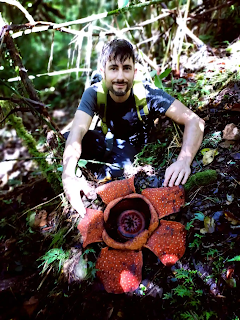
Chris Thorogood, the deputy director of the Oxford Botanical Garden and Arboretum, got equally excited just recently. A prime ambition had been to find a specimen of what he calls 'the world's most whopping weird plant', and he did it!  

And here is Chris and the flower he found.


He looks hot and tired but triumphant, and deservedly so.  As The Guardian describes, the search was a real struggle.

By the time he got there he had been stung by vicious plants, and bitten by nasty leeches. 

But what a find!


Friday, March 25, 2022

Review of DAUGHTERS OF THE STORM


When Helen Pederson enters the room at her estranged husband’s California estate, she expects to learn what hostess duties he needs her to perform this time. Instead, she is confronted by six individuals who together stir up a two-decades-old nightmare. Two she knows well. Her husband, Harold Pederson, runs the wealthy family empire that his grandfather founded. Once he makes a decision, it’s impossible to change his mind. The second is their daughter, Jewel, who suffers from a congenital mental illness that manifests itself in angry tantrums that have become more violent as she ages.

The other four people are Skye Hamilton, Maggie Bacchante, Jerry Giacomo, and Kate Giacomo. Skye is the business manager of Bacchante Wines. Maggie, whose family owns the winery, is an up-and-coming fashion designer. Although they are not related, she and Kate look amazingly like twins and they grew up together. Kate is a bestselling author. Her adopted father, Jerry, is a well-known fireman who specializes in fighting oil well fires.

Twenty years ago, in the midst of a hurricane, three babies were born: Jewel, Kate, and Maggie. Three little girls. Three identical cribs. Amid the chaos, no labels identified who was who or which baby belonged to which mother. Now, Harold wants to know which is truly his daughter. He has a plan to learn the truth – sail to the Pacific island where the hurricane hit – and he has the money to insure that no one refuses to accompany him on the cruise.

Druett steps away from her traditional historical fiction to craft a modern-day mystery. Her characters are well-developed and unique from each other, in spite of the similarities between Kate and Maggie. A shady sailing boat, a kidnapping, unexpected deaths, odd financial manipulations, a peculiar assistant, Jewel’s tantrums, and a brewing hurricane add further spice to the suspense. Stirring up the past is never a good idea and doing so often results in unintended consequences as Daughters of the Storm clearly demonstrates in a fashion similar to Agatha Christie’s The Mousetrap. Readers who enjoy this first offering in the Bacchante series will eagerly await the next book, Storm Swept.

With thanks to Cindy Vallar, Pirates and Privateers, who gave the book five stars.

Watch for Storm Swept, which is being published momentarily.

Thursday, March 24, 2022

Blacks in Whaling


I was very interested today to receive a link to an item in the Guardian featuring the discovery of the wreck of a little 94-ton whaler.  A brig. Though the journalists insist on calling it a whaleship, technically it was not.  As it boasted only two masts, it was a brig.

It is pretty certain that it was the brig Industry of Westport, Massachusetts, which was sunk in 1836.  And the evidence that it was a whaler is the block of bricks with two cauldrons set inside: the tryworks, where the blubber was rendered into oil.  You can see it in the photo.

Industry was an old name for many old whaling vessels, a reflection of how hard the men in the trade worked.  There were ships called Industry that sailed out of Nantucket, Boston, New Bedford, and Dartmouth, as well as Westport.  The earliest, according to Judith Lund's compendious Whaling Masters and Whaling Voyages, sailed out of Dartmouth in 1758, and the captain was Isaiah Eldridge.  The captain of the Westport vessel when it foundered was Hiram Francis -- or so says Alexander Starbuck, in his ancient History of the American Whale Fishery. 

Very little is known about this particular little craft.  Her builders and owners and managing agents were not recorded, but it does have the distinction of being on the only whaler that sunk in the Gulf of Mexico. Luckily for the 15-strong crew, the Westport brigs whaled in proximity to each other, and so they were rescued by the Elizabeth, which was close by, and which, coincidentally, was captained by the same man who had been the Industry's master the previous voyage, George Sowle.

And it was doubly lucky, as if the crewlist had included runaway Blacks, which happened often, they would have had a bad time if they had been forced to row to shore.

As I found out when researching In the Wake of Madness, which was the grim story of the murder of a Black steward by the certifiable captain of the Sharon (sister ship of Acushnet, where Melville sailed at the same time), the whaling industry was a refuge for runaway slaves.  Dominated by Quakers, the whaling villages welcomed Blacks, and some, like Paul Cuffe and Lewis Temple (the inventor of the toggle harpoon), became prominent in the business.


There is even a statue devoted to Temple in New Bedford, a testament to a liberal past.

Friday, March 18, 2022

TUBBY THE TUBER


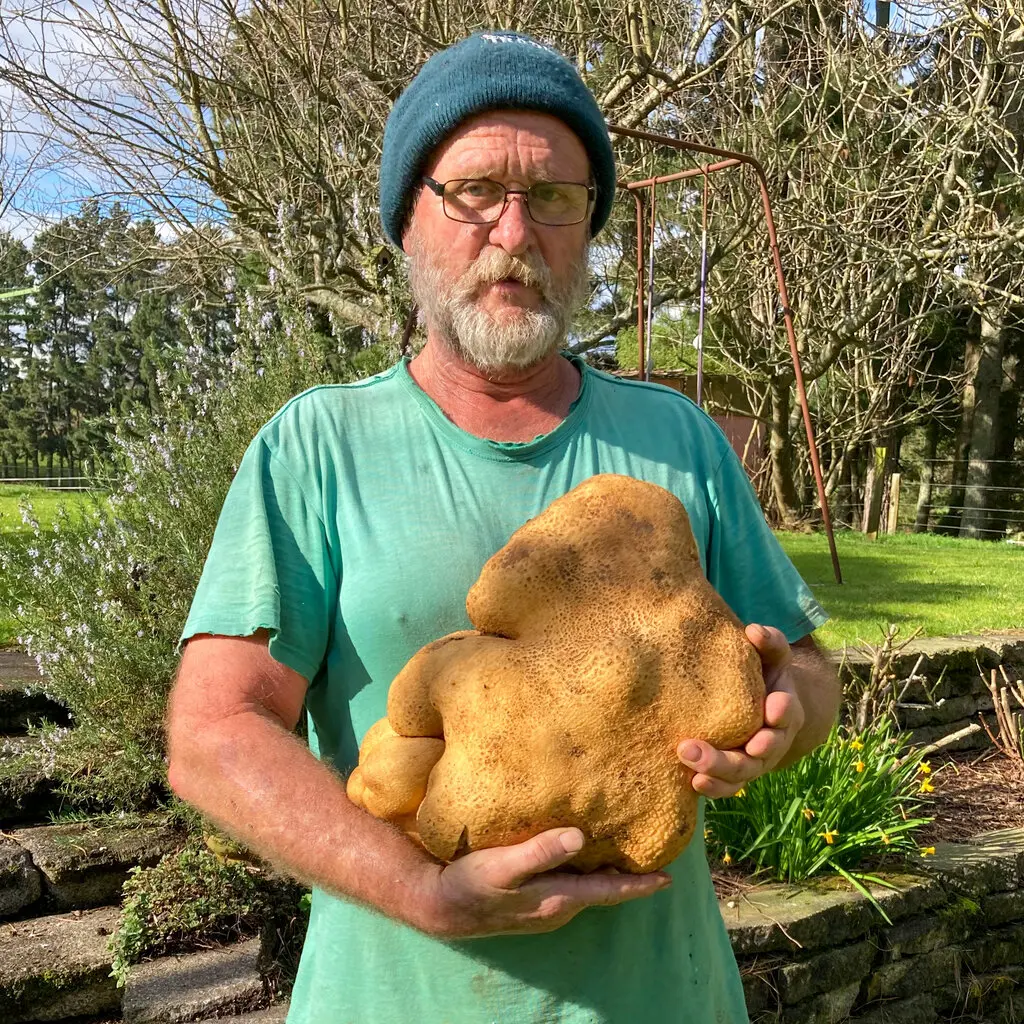
Well, we have all read the story of the giant whatever, that was dug out of a garden at a farm near Hamilton, in the North Island of New Zealand.

The couple who dug the giant whatever (promptly called "Doug") inspected it, weighed it, tasted it (that took courage!) and entered it into the giant Guiness Awards outfit, hoping to get it rated as the world's largest potato.

But, sadly, it was not a potato.  It was the tuber of a gourd.  Full stop.  Very frustrating.  Do gourds have tubers?  What did the parent plant look like? If Doug was dug back underground, what would sprout there-from?  But the mysteries are not to be solved.  Doug now languishes in the farmer's very large freezer.  Why?  I would like to know that, too.

The odd bit of news got published in the New York Times, which has a comments facility -- and readers took advantage of it, to display their witty puns.  Here are a few choice selections.

Charles E Dawson
Woodbridge, VA3h ago

Another sad example of the decline of the West. Doug, whatever it is, is fantastic, utterly cool. The response though is tragic. Science is by definition, curiosity. Yet it is not in evidence here; it ends with Doug is not a potato. I, for one, want to know more: What is it, is it edible, is it poisonous, what does it taste like, can it be grown, does it posses other beneficial properties ? Really, does this interest no one ? Are their souls so dead or jaded that some new lifeform is just shrugged off as another part of their daily drudgery ? It's not a potato. Done. Colonial Americans thought the tomato was poisonous; Spanish nuns created a business juggernaut when they added sugar to chocolate to aid people during fast days; George Washington Carver discovered a fabulous world in the peanut. Well, here's to Doug, the first, the best, and maybe the last, of his kind.Flag


Ryan Carlson
Minneapolis3h ago

Heads up guys, if you find a large deposit of apparent gravy nearby, don't taste it!


Dquixote
LaMancha5h ago

Poor Doug is an orphan, but loved nonetheless. Very cool and a lot happier than watching Putin destroy Ukraine.

Basho
Nevada City, Ca5h ago

I first read about this in the underground press.


Mensabutt

Clearly not a tuber. Threeber, certainly, and quite possibly a fourber. And is it measured in metric, or in real math?


Peter Stix
Albany NY7h ago

They should put it on a webcam and stream it. A 17-pound youTuber (Sorry, but the proliferation of puns required further punishment.)


HJB
New York8h ago

This tuber, from down under Should not have had its hopes cast asunder It should have earned a Guinness award For being a unique organic abstract, in the form of gourd.


Justintime73
Linwood8h ago

tuber or not tuber, that is the question