Unicorn is sent into the troubled waters of the Adriatic. His mission: to scourge the sea of pirates and turn the Serene Republic of Venice against Revolutionary France.
But Nathan is soon drawn into a much more sinister web. At its heart two of the most feared women of the age: Emma Hamilton, the courtesan turned courtier, and the nun Caterina Caresini, uncrowned queen of Venice. And--most feared of all--the mysterious agent of the Three Inquisitors, known as Il Diavolo, the Devil.
As Nathan confronts the politics of "intrigue, poison and the stiletto," he plays a deadly game with the ambitious young general Napoleon Bonaparte. In a bid to save the British fleet, Nathan joins forces with Horatio Nelson for a dramatic breakout from the Mediterranean and a perilous battle off Cape Saint Vincent that could change the very course of the war.
Praise for the Nathan Peake series--
"[Hunter] delivers another slick nautical adventure in the Patrick O'Brian tradition . . . The rousing naval battles, twisty plot, and muscular prose lift Hunter's nautical yarn a few notches above the competition." --Publishers Weekly
"A compelling read, imaginative, knowledgeable, fast moving . . . full of twists and turns." --Naval Review
Singapore, November 1941: Lieutenant Ralph Trewin, a proud recipient of the Distinguished Service Cross, arrives at Singapore as second-in-command of the shallow-draught gunboat, H.M.S. Porcupine. To Trewin, still shocked from wounds received during the evacuation of Crete, the gunboat and her five elderly consorts symbolise the ignorance and blind optimism he finds in Singapore. And the captain of the Porcupineis as unwilling as the rest to take heed of Trewin's alarm, for to him the gunboat represents his last chance.
One month later the Japanese invade Malaya and three months after that Singapore, the "Gibraltar of the Far East"--a British rock that could not be taken--knows the humiliation of surrender. Through the misery and despair of this bloody campaign Trewin and his captain are forced to draw on each other's beliefs and weaknesses, and together they weld the little gunboat into a symbol of bravery and pride.
The National Medal for Museum and Library Service is the nation's highest honor given to museums and libraries by the Institute of Museum and Library Services (IMLS), in recognition of exceptional service to the community and for making a difference in the lives of individuals, families, and communities.
This year's finalists include individual public libraries, special and research libraries, science museums, botanical gardens, children's museums, and many other types of institutions that exemplify the great diversity of libraries and museums across the country.
We are thrilled to share that the Nantucket Historical Association
has been named as a finalist for the
2016 National Medal award (the second time in two years)!
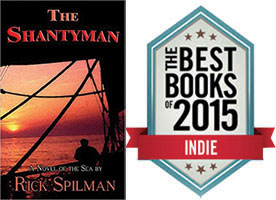
The Shantyman – One of Kirkus’ Best Indie Books of the Year 2015
A highlight of the year was the announcement that Rick Spilman’s novel “The Shantyman” was selected as one of Kirkus Reviews’ Best Indie Books for 2015.
From the review: With eloquent accuracy, Spilman’s novel captures the life of a 19th-century sailor…. Spilman’s
colorful, well-researched novel will enthrall both sailing enthusiasts
and landlubbers. A fabulously gripping sailor’s yarn.
Sex in the Sea: Our Intimate Connection with Sex-Changing
Fish, Romantic Lobsters, Kinky Squid, and Other Salty Erotica of the
Deep. By Marah Hardt. St Martin’s Press; 257 pages. $26.99.
IN THE Olympics of extreme sex, the gold medal, says Marah Hardt,
goes to fish and other saltwater species. Sea life depends on
sophisticated strategies honed over millennia to meet and mate. The
ocean covers 71% of the Earth’s surface, so hooking up in a singles bar
spread over 1.3 billion cubic kilometres (0.3 billion cubic miles) is no
easy task. Reproduction and survival of the sexiest is what it is
about.
Though it finishes on a more sombre note, Ms Hardt’s book, “Sex in
the Sea”, starts as a voyeuristic romp (“Oceanic Orgies: Getting It On
in Groups” is one chapter title). Cuttlefish are cross-dressers, the
male argonaut (a pelagic octopus) has a detachable, projectile penis,
dolphins are in flagrante acrobats, and group sex erupts (where else?)
on the California coast twice a year when tens of thousands of grunions
disport themselves on the beach. Led by the moon and tides, the small
fish fling themselves ashore. The female digs a hole in the sand with
her tail, backs in, lays eggs, and waits while up to eight males snuggle
up and release their sperm. Kama Sutra, meet Jacques Cousteau.
Oceanpornography-cute aside (the last section, is, predictably, “Post
Climax”), there is a sober moral to the story. Because of the heavy
human footprint, even the cleverest underwater sex strategy struggles to
succeed. The sea is becoming unsustainable. A recent World Wildlife
Fund report warns that the mammals, birds, reptiles and fish that rely
on the sea have been reduced by half in the past 40 years, mostly
because of overfishing. According to the UN’s Food and Agriculture
Organisation, consumption per person has nearly doubled from 10kg
(22lbs) in the 1960s to more than 19kg in 2012. Other insults include
global warming, plastic rubbish (which kills marine mammals by
strangulation or ingestion of debris) and acid rain. The undersea
reproductive race is sometimes lost before it has begun. “It is tough to
perform under pressure,” Ms Hardt says.
Still, she is heartened by the number of countries willing to create
protected areas. Last March the British government set aside 834,000
square km (322,000 square miles) of ocean for the Pitcairn Islands
Marine Reserve—the largest single marine protected area anywhere. Other
moves include implementing no-take zones, developing underwater
ecotourism, recycling ocean trash and insisting on sustainable fishing.
Even so, some scientists worry that it may be too late. To ensure that
undersea sex is not subverted by overfishing and environmental
degradation will require global co-operation. Otherwise, we are in for a
very sad love story.
Sydney (AFP) - A letter from a man to his
mother flown out of Paris by hot air balloon during the Prussian siege
in 1870 has turned up in Australia's National Archives, which said on
Tuesday it was keen to discover the family's fate.
The Franco-Prussian War saw the Germans completely surround Paris for more than four months that year.
Balloon
mail was the only way communications from Paris could reach the rest of
France, with dozens of flights made, mostly at night, and hundreds of
thousands of letters delivered.
One of them has been discovered by the National Archives. It was
penned in French on December 6, 1870 by a man named Charles Mesnier (or
Mesmier) to his mother, care of Monsieur Grussin (or Grossin) at 8 Place
de la Ville, Pont-Audemer, in Normandy.
"It's a
intriguing human element to an important piece of history," National
Archives assistant director-general Louise Doyle told AFP.
"We're
not sure how it ended up in Australia, but it would be fascinating to
know more. If people see this it would be interesting to have more
context in relation to this record."
The letter was
transferred to the archive's Brisbane office from the former Queensland
Post and Telegraph Museum in 2001, but there is no information about its
origin.
It came to light recently as part of a
joint project between the National Archives of Australia and the
Archives Nationales in France.
In the letter, which is full of fervour, the man assures his mother he is in good health.
"We
don't have meat every day and when we do get some it is not very much,
but we can easily get by as things are and no one in our household is
complaining," he wrote.
Mesnier added: "The desire
to repulse the Prussians is right now the solitary concern of Paris. Any
suffering can be borne rather than opening the gates of the capital to
them."
He goes on to speak of "some real battles" around the city between
November 29 and December 1 in which "our young soldiers have beaten the
seasoned Prussian army".
"We have taken their cannon
and captured 1,000 prisoners -- these days of good fortune have raised
the morale of the fearful," he said.
"We cannot
succeed in all our attacks but I have the firm conviction, my good
mother, that the ultimate success will be for our just cause."
His hopes were dashed, with the city surrendering in late January 1871 after sustained bombardment.
Mesnier
could not have expected a reply from his family. While the prevailing
winds sent the balloons over the heads of the Prussian army towards
French lines, they could not go the other way.
The
single-sheet letter is just 207mm x 133 mm (eight by five inches),
folded into an envelope with the address on the reverse side and Eure,
the department where Pont-Audemer is located, written on the top left
along with "par ballon monte" -- for delivery by hot air balloon.
Doyle said it was sent on December 7 and arrived in Pont-Audemer on the 16th.
"He's
saying to his family not to worry about him and he's really at the
point of saying the city is pushing back against the Prussians," said
Doyle.
"It's one of those quirky and unusual documents and it would be fascinating to learn more."
How
the Profit Motive Can Solve Hunger, Poverty, War, and Catastrophic Climate
Change
By
Shel Horowitz
Two years ago, I finally figured out what I want to be when I
grow up: the person who proves that the business world can end hunger, poverty,
war, and catastrophic climate change.
Not through guilt or shame—through enlightened self-interest:
profit. Developing a core business identity based in social transformation,
creating/marketing products and services that address these issues directly.
Let's make that concrete:
• Example 1: inexpensive, profitable solar-powered
LED lanterns eliminate kerosene's toxic fumes and deadly fires…fund the
purchase out of a household's existing kerosene budget…provide better light,
enabling kids to get better grades and parents to take on a cottage
industry—ladders out of poverty (at least three companies make these)
• Example 2: holistic design: without furnace or
AC, you can save 80% energy/carbon. nature knows how to build a curved anthill
that withstands both India's intense monsoon flooding and the inhospitable dry
climate the rest of the year.
• Example 3: self-feeding loops grow mushrooms on
the spent grain from a brewery, feed the mushroom waste to a tilapia (fish)
crop, and uses the fish nutrients to grow gourmet salad greens. This cycle
creates new jobs, improves quality of life *and* food self-sufficiency, and
restores polluted water—all at once.
Pretty cool, huh? I've spent the past two years looking at
how systemic thinking can eliminate scarcity, balance the planet, and promote
peace.
My 10th book, Guerrilla Marketing to Heal the World, comes
out in April, with 22 endorsements including Jack Canfield and Seth Godin, and
four essays from Cynthia Kersey (author of Unstoppable/Unstoppable Women),
Frances Moore Lappé (Diet for a Small Planet), Yanik Silver (Evolved
Enterprise), and Ken McArthur (The Impact Factor). It's the best thing I've
ever done.
If enough people read it, this book can change the world!
Learn more:
*** Green/social change business profitability expert Shel Horowitz shows you how profit by greening your business, turning hunger and poverty into sufficiency, war into peace, and catastrophic climate change into planetary balance, and marketing these commitments. Shel’s 10th book, Guerrilla Marketing to Heal the World (Morgan James Publishing), highlights profitable and successful socially responsible strategies used by companies from Fortune 100 to solopreneurs. To discuss your next project with him or schedule a no-charge 15-minute strategy session: shel [AT] greenandprofitable.com, 413-586-2388 (8 a.m. to 10 p.m., US Eastern Time), Twitter: @ShelHorowitz
Andy Weir's The Martian eventually went on to become a Hollywood
blockbuster. But the story was originally published chapter by chapter
on the author's blog for free.
Oscar-nominated film The Martian starring Matt Damon began life as a self-published book
This turned out to be great exposure and it became a huge hit as an audiobook, e-book and physical book.
"There
was an adversarial attitude between mainstream publishing houses and
self publishers a few years ago," says Mr Bond, "but I think that's
changed dramatically."
He attributes this to traditional
publishers' new-found admiration for the self publishers' social media
skills, which have helped them find new readers without the benefit of
expensive marketing campaigns.
Lawyer-turned-author Mark Dawson, for example, uses his website and Facebook page
to give out free copies of his thrillers and curates 'Readers' Groups'.
Online conversations help him establish a closer relationship with his
readers encouraging them to come back for subsequent publications.
Another thriller writer Joanna Penn has bolstered her following by helping others to self-publish through her website which explains how to go about self publishing. She also hosts a popular podcast interview series.
So-called "Instapoets" like New Zealander Lang Leav have built up huge followings on Instagram and Tumblr, publishing their work on these platforms, before securing traditional publishing deals.
Also see my own help site for prospective Indie authors, www.kindlepublishinghints.blogspot.com
There are cautionary tales as well as successes, however. READ MORE





 Sex in the Sea: Our Intimate Connection with Sex-Changing
Fish, Romantic Lobsters, Kinky Squid, and Other Salty Erotica of the
Deep. By Marah Hardt. St Martin’s Press; 257 pages. $26.99.
Sex in the Sea: Our Intimate Connection with Sex-Changing
Fish, Romantic Lobsters, Kinky Squid, and Other Salty Erotica of the
Deep. By Marah Hardt. St Martin’s Press; 257 pages. $26.99.


